


Tell us about yourself.
I’m Sebastian Sickmann. I’m Team Lead of BEUMER Group Evolution at BEUMER Group. We are the innovation lab within the BEUMER Group, tasked with looking into the future. As part of the innovation department, we aim to envision a future where technologies converge. Our task is to explore new technologies on the horizon; in innovation theory, these are known as ‘Horizon 3′ technologies. We want to explore whether these technologies could really add value to our system and to our customers’ operations.
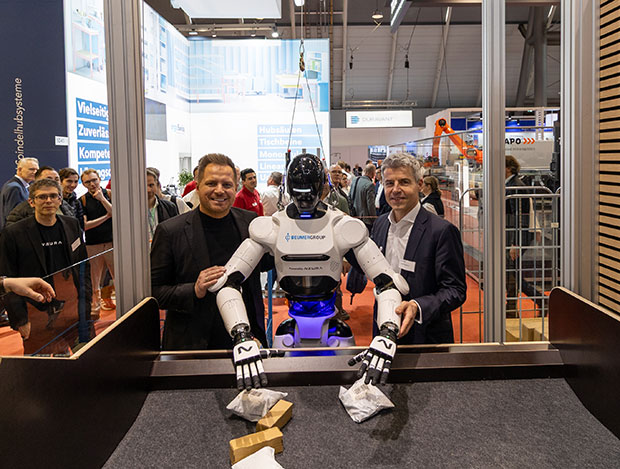
Your stand had an innovation Corner. Can you explain what this is and what it’s trying to show to visitors to the stand?
In our Innovation Corner, we are showcasing a humanoid robot. We think there are two major discussions going on. One is the labour shortage — a topic we have been discussing for decades. This is nothing new for intralogistics. But now there is a second issue: the growth of technology. Robotics and AI are now converging, making physical AI possible. We believe that physical AI is the right solution to address the labour shortage issue. We want to engage with our customers and discuss whether they also see potential in this technology. BEUMER Group certainly does.
Often, the question is raised: when will this technology be available? The answer is we don’t know. We don’t want to say it will be one year, five years or ten years. We think it will happen, but we want to work with our partners and customers to investigate where the future lies.
Who is helping you develop this technology?
On the technology side we have collaborated with Neura Robotics. It’s a German company that specialises in physical AI. They already have expertise in collaborative robots but are now also moving into humanoid robots. We are now looking for additional partners from the operations and production side, our customers, to investigate whether we can apply these robots to their facilities.
Apart from staff shortages, what other key areas do you think this technology can help with?
These robots are flexible and have cognitive skills. They can hear, listen and feel like human beings, which is what makes them unique. Furthermore, these humanoid robots especially score in terms of flexibility and scalability. This is where we see their value.
Within the warehouse, what are the key things that this technology is going to help develop?
What we want to do now is to investigate this area together with our customers, because they know better than anyone where the problems are, but also where the potential lies. We don’t believe in a 100% dark warehouse or lights out. We don’t believe in eliminating human beings 100%. This is also not in BEUMER’s DNA. We see potential in combining humanoids with humans because we believe that we still need people in the warehouse. This is why we want to stay ahead of the competition and actively shape this topic.
What potential do you see for this application going forward five years or 10 years?
We will need to think about intralogistics anew when these humanoids can work 24/7, when we can trust them 100% and when they are fully reliable. But we aren’t there yet.
Are there any other things that you’re going to be looking at within the business centre?
We are now looking for colleagues in the intralogistics network who want to work together to shape the future, because we strongly believe that we can’t do it alone. We believe that it takes a collective effort, and this is the message we want to convey: let’s work together. This aligns perfectly with our BEUMER DNA — we want to be “Your Partner of Choice” through differentiation and collaboration. We can only achieve success through collaboration.
Comments are closed.