


Across warehouse operations, facilities management and maintenance, working at height, particularly at low levels, is a routine part of daily operations. For decades, organisations have relied on a mix of access methods, each chosen according to the task at hand. However, as safety culture evolves, many warehouse and logistics operations are now taking a fresh look at the options available, writes Samuel Butterworth, Business Development Manager UK & I- LLA.
The scale of the issue
Low level access tasks may feel like a standard part of daily operations, but they carry significant risk. UK data continues to show the impact.
Over the last decade, an estimated 425,000 nonfatal falls from height have occurred1 and around 37,0002 workers self-reported a fall related injury in the last annual period. Nonfatal falls from height result in approximately 688,000 lost working days3 per year, costing the economy around £850 million4. Falls from height can also prove fatal, and are the leading cause of death among workers, with 35 fatalities in 2024/255.
At the same time, musculoskeletal disorders (MSDs), often linked to repetitive reaching, constrained posture, and manual handling, affected more than 511,000 workers6 in 2024/25 and led to 7.1 million lost working days7. These strains have great potential to occur in environments where workers regularly work at height.
The causes may be multi-faceted. However, it is important to recognise that task intensity, frequency, and equipment ergonomics matter when it comes to protecting people. Modern solutions such as powered access equipment may help reduce the strain on people performing these tasks day after day.
What is low-level access?
When talking about low-level access, this typically refers to a working height of 5 metres and below. This may not sound like a high elevation, however, this constitutes working at height for the purposes of safety. The Health and Safety Executive (HSE) guides that working at height means working anywhere where, if no precautions are taken, a worker could fall a distance liable to cause personal injury.8
Falls from height can be a symptom of a failure to take the right measures, whether that is training, equipment choice, or operator behaviour. Falls tend to be predictable outcomes of predictable habits, like overreaching, carrying tools while climbing, or working onehanded to maintain balance.
The HSE makes its position clear. As much work as possible should be done from the ground, and advises organisations to follow a simple hierarchy of control for work at height:9
1.Avoid working at height where possible
2.Prevent falls using appropriate equipment
3.Minimise the distance or consequences of a fall if one occurs
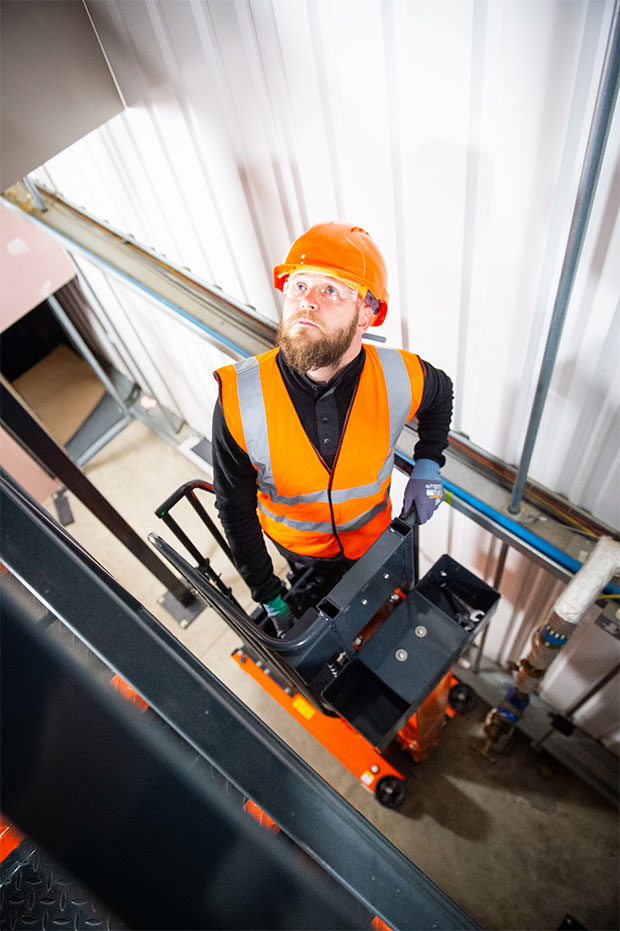
Modern LLA solutions can support this hierarchy by providing stable, secure enclosed platforms, reducing the need to overreach or adopt awkward positions, and eliminating the need to climb in many scenarios. For instance, choosing JLG Power Towers models may help warehouse and plant managers take a more controlled, consistent approach to repeated routines.
Designed for people, not just productivity
Today’s workforce not only expects equipment that keeps them safe, but also supports comfort, efficiency, and long term health. Modern low level access platforms have been designed with these expectations in mind.
•Designed with ergonomics in mind – JLG Power Towers LLA solutions provide space to support natural working postures, which may help reduce shoulder, wrist and back strain common in overhead and repetitive work.
•A stable platform for focused working – Guardrails and enclosed platforms are designed to provide collective fall protection, supporting workers to concentrate on the job rather than maintaining balance.
•Reduced climbing requirements – Many platforms are designed to reduce the need for climbing, which may help reduce the strain associated with repeated ascent and descent during busy shifts.
•Space for tools and materials – Having equipment at platform height can help reduce unnecessary reaching or improvisation and supports more organised, efficient work.
When a worker feels comfortable, supported, and confident at height, the quality and consistency of their tasks may improve naturally.
None of this diminishes the ongoing role that ladders, scaffolds, or podiums have in many workplaces. It demonstrates how a broader selection of tools helps employers choose the right method for the right task.
It helps maintenance teams and health and safety professionals in warehouse and logistics operations to create a culture that puts people first, with ways to select equipment that helps demonstrate strong risk management, aid long-term workforce wellbeing, and optimise productivity.
Confident to choose the best option
Equipment operators have a vital role to play. Every worker should feel empowered to ask questions about how they complete their tasks. Maintenance teams, warehouse operatives, or anyone working at height needs equipment that supports them, protects them, and enables them to produce their best work. Employees should have the confidence to ask: “Is this the best way to work at height today?”.
Smart future solutions
Work at height is not going away, but the way organisations approach it continues to evolve. With a wider range of access methods, including modern low level access platforms, employers can support teams with equipment that fits today’s expectations of safety, ergonomics, and productivity.
This is not about rejecting traditional methods; it is about expanding what’s possible and reducing avoidable risks. Because safety shouldn’t rely on luck, and people deserve better.
1 No Falls Foundation: 10-year Trend Analysis on Falls — estimates up to 425,000 non-fatal falls from height from LFS data. (No Falls Foundation).
2 Access Industry Forum commentary (which uses HSE/LFS data to estimate up to ~44,000 LFS self-reported falls and previous figures around 37,000). (accessindustryforum.org.uk) In the 2023/24 period, approximately 37,000 people self-reported a fall-related injury at work, roughly 100 people every day.
3 In 2023/24 alone, non-fatal falls resulted in 688,000 working days lost. Source: Access Industry Forum (citing HSE cost and lost-time data estimates). (accessindustryforum.org.uk).
4 Commonly cited by C. Access Industry Forum referencing HSE cost model estimates—historical figures around £847 m–£850 m per year. (No Falls Foundation). The annual cost of non-fatal falls from height is estimated at £850 million. This includes costs to the employer (sick pay, lost productivity), the individual (lost earnings), and the government (tax losses/benefits).
5 A. HSE: Health and Safety at Work Summary Statistics 2024/25 release & B. HSE Work-related Fatal Injuries in Great Britain (2025) — 35 deaths due to falls from height reported by HSE. (HSE).
6 – Source: A. HSE: Health and Safety at Work Summary Statistics 2024/25 release — shows 511,000 suffering from work-related MSDs. (HSE).
7 HSE summary shows work-related ill health resulted in 40.1 m lost days overall; MSD portion is significant — historic figures for MSD lost days hover in the millions. (HSE) Working Days Lost: MSDs accounted for 7.1 million working days lost in 2024/25; each sufferer ~14 days off.
8 Health and Safety Executive. Introduction to working at height safely. Available at: https://www.hse.gov.uk/work-at-height/introduction.htm. (Accessed 4 July 2024).
9 Health and Safety Executive. Working at height: A brief guide. Available at: https://www.hse.gov.uk/pubns/indg401.pdf. (Accessed 4 July 2024).
Comments are closed.