



One of the first questions operators ask when considering electric refrigeration is simple: Do we need to redesign our operation to make this work?
It’s a fair concern. New technology often brings hidden complexity — new infrastructure, new processes, and potential risk to already finely balanced logistics operations.
But real-world deployments are starting to tell a different story.
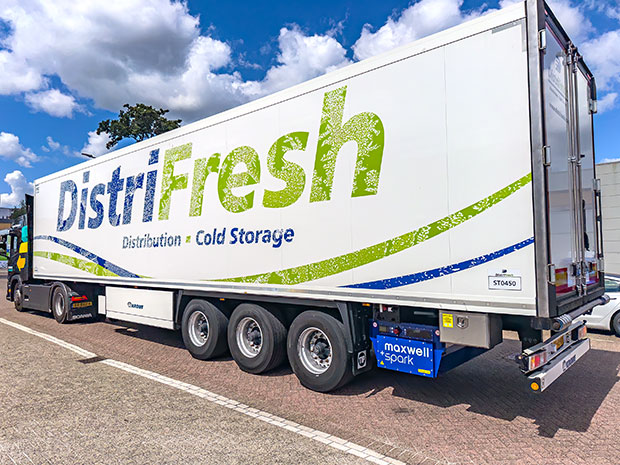
Working with Distrifresh, a Dutch temperature-controlled distribution operator, maxwell+spark analysed nearly two years of real-world performance data from its advantage.li battery-electric refrigeration systems operating across daily delivery routes. The focus was not on isolated performance, but on how the system behaved within the realities of day-to-day operations.
The results were clear.
Charging took place during standard depot dwell times. No additional infrastructure was required. There was no need for mid-route charging, and no redesign of delivery schedules. In practice, the system integrated into the existing operation rather than requiring the operation to adapt to it.
Across more than 1,800 monitored routes, approximately 95% were completed without any low-battery risk or operational disruption. Median battery usage per route remained low, indicating significant reserve capacity for longer or more demanding conditions.
In the small number of cases where demand exceeded expectations, the system’s hybrid capability ensured continuity, with diesel backup available as needed.
What this shows is important, namely that electrification does not need to be an all-or-nothing transition. When designed correctly, it can be introduced into existing fleets and workflows, delivering immediate benefits without operational upheaval.
At the same time, the data reveals something more.
Because systems like advantage.li generate continuous telemetry, they offer visibility into how refrigeration is actually used — how long systems run, how energy is consumed, and where inefficiencies may exist. In the Distrifresh case, this translated not only into operational stability, but also into measurable cost impact. Based on observed runtime and energy use, electric operation reduced energy costs by up to ~80–85% compared to diesel, depending on duty cycle and pricing assumptions.
For operators, this changes the nature of the decision.
Electrification is no longer just a sustainability initiative or a future ambition. It becomes a practical, measurable step that can be taken within existing operations.
And increasingly, it is not just about replacing diesel with electricity. It is about moving from fuel consumption to operational insight — from diesel to data — and using that visibility to better understand and optimise how the cold chain actually runs.
Comments are closed.