



Exotec, a designer and integrator of robotic solutions for warehouse logistics, has announced the deployment of a multi-site programme called Skyfleet® for Decathlon.
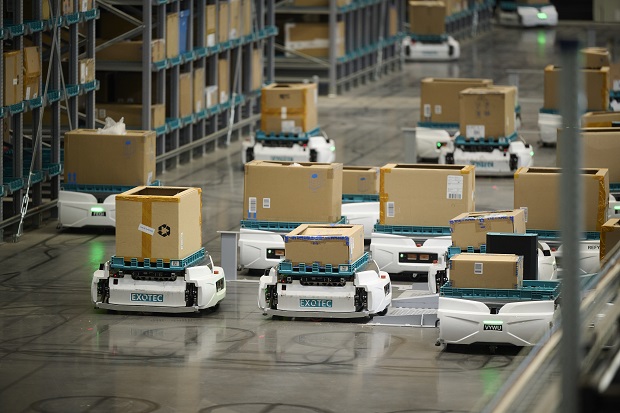 The program spans seven logistics platforms across five European countries: France, the United Kingdom, Portugal, Italy, and Germany. Beyond enabling Decathlon to standardise and manage logistics flows at a European scale, the programme has also improved working conditions within warehouse teams.
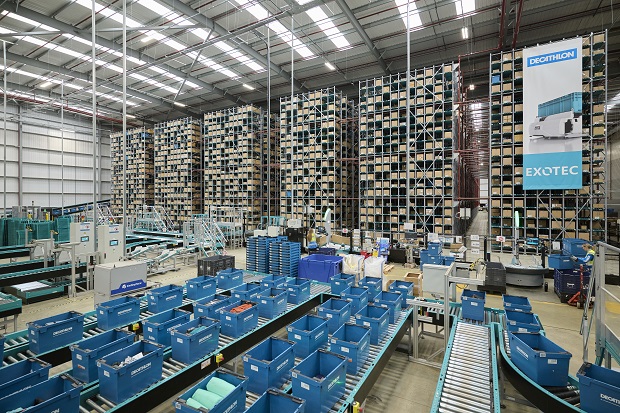 This initiative marks a new milestone in positioning Exotec as an end-to-end integrator, orchestrating all warehouse flows and equipment – from inbound to outbound – within a unified architecture.
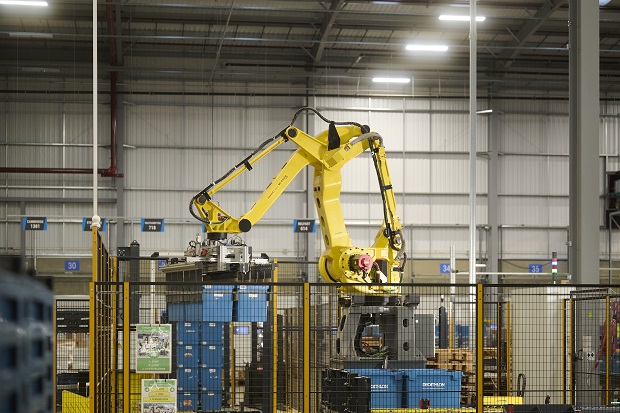 The programme created for Decathlon is a dedicated implementation of this approach, designed to accelerate multi-site deployments internationally through process standardisation.
Standardising store replenishment across Europe
After deploying its first Skypod® robotic system at the Tilburg site in 2021, Decathlon chose to expand the partnership with an even more ambitious project, standardising store replenishment across the European continent.
Exotec developed a dedicated programme built on a harmonised, replicable, and scalable architecture; one that enables the rollout of a standardised model while still adapting to each site’s specific requirements.
Each Skyfleet system follows a consistent configuration:
- A fleet of 150 to 200 Skypod robots
- 100,000 to 125,000 storage locations
- 3,000 to 4,000 order lines per hour
- 150,000 to 200,000 items processed per day
- 7 to 13 picking stations (single stations and stations with order movers)
- Parcel buffering before expedition within the same storage system
- Full automation of inbound and outbound flows
Standardised end-to-end integration
At every Decathlon site, Exotec systematically integrates additional automated equipment to optimise intralogistics processes: automatic depalletisers, automated carton-opening machines, RFID tunnels, automatic palletisers, and more.
For these specialised machines, whose selection during the design phase can be costly and time-consuming, mutualising choices across sites generated significant economies of scale.
Beyond system design, the shared structure and learnings gathered throughout the programme help accelerate deployment phases, particularly the performance ramp-up period.
As with all Exotec projects, flow orchestration and equipment coordination are handled by Deepsky®, Exotec’s proprietary warehouse execution system (WES). This software layer unifies interfaces and ensures seamless endtoend operational continuity. Standardising sites also enabled Exotec to develop a single software codebase, shared across all seven warehouses, and simplifying deployments further.
Collaborative technology benefiting teams
Standardisation also made it easier to support and train teams adopting new technologies. By eliminating most heavy manual handling, employees were able to upskill and take on new activities while continuing to support the company’s growth.
The Skyfleet programme significantly improved working conditions for Decathlon warehouse teams. For example, at the Northampton (UK) site, a picker would walk 10km per day, but within the new programme, they now walk just 1km per day. The number of workplace incidents related to order preparation has also sharply decreased, from one per 5.000 to 1 per 10.000”
Significant performance improvements
The new implementation enabled most Skyfleet sites to increase the number of Decathlon stores they supply. This is the case, for example, in Ferrières (France), now supplying 73 stores vs 37 previously, and in Setúbal (Portugal), which now supplies 73 stores vs 41 previously.
The number of orders prepared daily also increased significantly. The Setúbal site now prepares 114,000 orders per day, compared with 57,000 before Skyfleet’s implementation.
Standardisation has also streamlined operations and long-term maintenance. While each site remains locally managed, Decathlon has introduced harmonised tools and dashboards, enabling teams to compare performance, share best practices, and optimise operations across warehouses.
Each system is designed to adapt to evolving customer needs and support volume surges. For example, robots have been temporarily transferred between warehouses to support peak activity in specific countries. Additionally, the Ferrières site has already ordered 13 additional robots.
“We were looking for a partner to support our logistics network rationalisation project. We chose Exotec because they were able to deploy multiple sites in a short time and integrate scalable solutions that evolve with our needs. In five years, we have profoundly transformed the workplace experience within our warehouses and written the next chapter of logistics at Decathlon,” said Jérôme Saillour, Head of Logistics Automation at Decathlon.
A standardised architecture to drive performance at European scale
Through its multi-site deployment programme, Exotec has reinforced its position as an endtoend integrator capable of supporting international warehouse automation projects.
“When we launched our first Skypod robotic system nearly ten years ago, we brought more flexibility and resilience to storage and order preparation. As intralogistics has become a strategic priority for our clients, we now create value throughout the entire warehouse. With the Skyfleet program, we have demonstrated our ability to orchestrate multi-site deployments,” explained Romain Moulin, co-founder and CEO of Exotec.
Comments are closed.