



The delivery forms part of a major Dutch hydrogen innovation project, supported by the EU, to help assess lower-emission solutions for heavy-duty materials handling applications.
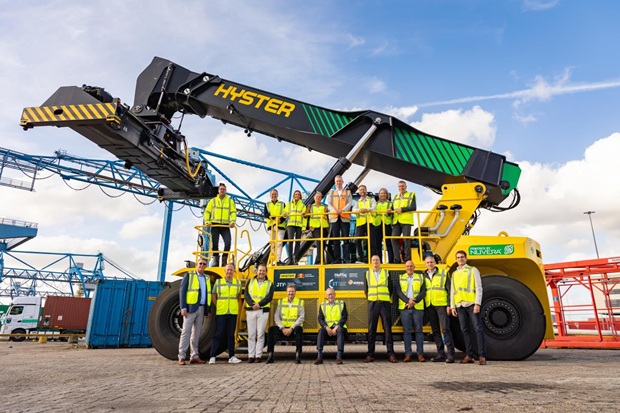 A hydrogen fuel cell-powered Hyster® ReachStacker has been delivered to Rotterdam Shortsea Terminals (RST) in the Netherlands as part of a joint initiative exploring the role of hydrogen in the future of port and logistics decarbonisation.
The ReachStacker will support operations in Europe’s largest dedicated shortsea shipping hub, primarily handling 45-foot containers, including open-top containers. To support these requirements, it is equipped with a specialised 45-foot spreader. The Hyster RSJ46-33XDH/62 ReachStacker is powered by a Nuvera 60kW fuel cell engine that converts hydrogen into electricity to support a 130kWh lithium-ion battery. It also incorporates the standardised Hyster software architecture used across other Hyster electric products, helping provide common operator experience, diagnostics platform, and service approach.
“Ports and terminals are under increasing pressure to lower emissions without compromising operational performance,” explains Lucien Robroek, President, Global Big Trucks, Hyster. “Hydrogen fuel cell technology has the potential to play an important role in applications where equipment must combine zero tailpipe emissions with the power and uptime required for intensive container handling. Working alongside RST and the wider project team will help further our understanding of how this technology can support the future needs of the industry.”
The ReachStacker has been supplied by Hyster and local authorised dealer, Heffiq, as part of a five-year innovation project supported by the Province of South Holland and the Just Transition Fund (JTF). Rotterdam Shortsea Terminals, Berkman Energie Services, Hyster, STC Next and HarbourHUB are joining forces within the JTF programme to make port logistics more sustainable. Together, they are developing a unique field lab in which two key innovations will be demonstrated: a modular hydrogen refuelling station and an H2 ReachStacker developed in the Netherlands.
This living lab demonstrates how hydrogen can be effectively integrated into logistics and industrial processes independently of the electricity grid. The ReachStacker deployment will also enable RST to gain practical operational experience with hydrogen-powered container handling equipment in its demanding port environments.
“For us, sustainability is not just an ambition for the future; it is about the choices we make today,” says Arno Storm, CEO of RST. “This hydrogen refueling station and hydrogen fuel cell-powered ReachStacker allow us to explore the transition in practice. We want to play our part, learn along the way, and contribute to a cleaner and more sustainable future for the generations to come.”
Local authorised dealer Heffiq will support the ReachStacker through its established service infrastructure and expertise in port and terminal applications, while Hyster experts will work alongside the dealer and customer throughout the project.
“RST has been a valued Heffiq and Hyster customer for many years, and we are proud to support them on this next step in their sustainability journey,” says Martijn Veerkamp, Commercial Director, Heffiq. “Projects like this depend on strong collaboration between customers, technology providers, and service partners. By combining our local expertise with Hyster innovations and RST’s operational knowledge, we have been able to bring a pioneering solution into a live terminal environment where it can deliver meaningful insights.”
In addition to technological innovation, the partners in the JTF programme are investing in human capital. In a joint experience centre, employees, students, and logistics professionals will be trained for the energy transition and in the safe and efficient use of hydrogen. The project, which is co-funded by the European Union, directly contributes to CO2 reduction, future regulations and standardization, and a better energy balance within the port. In doing so, it provides a powerful impetus for the sustainable transformation of port logistics in Rotterdam and beyond.
“South Holland is at the forefront of the energy transition. Innovative projects like the Hyster Hydrogen ReachStacker keep us there,” concludes Jeroen van Dijken, South Holland Provincial Executive. “We are creating opportunities to accelerate innovation by bringing together pioneering companies, educational institutions, and public partners. This strengthens our regional economy and prepares our workforce for the industries of the future. The knowledge gained through this initiative will reinforce South Holland’s position as a leading hub for sustainable logistics and clean energy development.”
For more information, visit www.hyster.com
Comments are closed.