



Three months on from the ABA’s updated workplace transport groupings taking effect, the Association of Industrial Truck Trainers (AITT) is urging employers and training providers not to mistake a simpler framework for a lower bar.
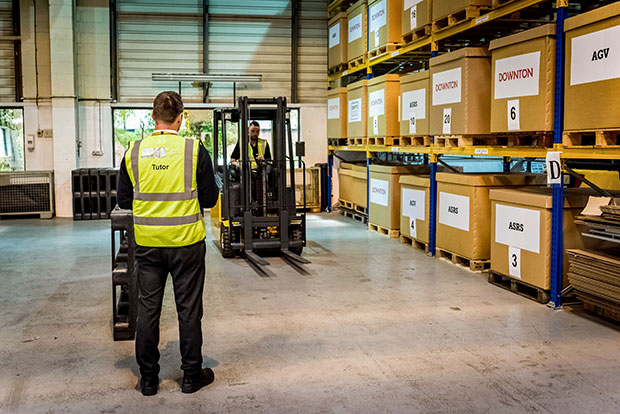
The Accrediting Bodies Association for Workplace Transport (ABA) introduced revised groupings in January 2026, developed alongside the Health and Safety Executive (HSE), the UK Material Handling Association (UKMHA), and accrediting bodies including AITT, RTITB, ITSSAR, NPORS, and LANTRA. The changes modernise how truck types are categorised, removing outdated limitations — such as arbitrary height restrictions — and better reflecting the range of equipment in use today.
That’s the good news. The concern is what happens next.
As businesses begin applying the updated structure in practice, AITT is concerned that broader groupings could be read as broader competence, with some operators assumed to be covered for equipment they haven’t been specifically trained on. That assumption would be wrong, and potentially dangerous.
Liam Knight, Managing Director of AITT, puts it plainly: “Treating this as a relabelling exercise misses the point entirely. The categories have been streamlined — that’s a positive step. But competence is still equipment-specific. An operator trained on one type of truck isn’t automatically competent on another just because they now sit in the same grouping.”
The legal picture hasn’t shifted either. Employers remain bound by the same duties under the Health and Safety at Work etc. Act 1974, PUWER 1998, LOLER 1998, and the Management of Health and Safety at Work Regulations 1999. None of those obligations were altered by the ABA review, and none of them allow for assumptions about competence.
“The structure has changed. Responsibility has not,” Knight continues. “Employers still need to assess each operator’s competence against the specific equipment and tasks they’re carrying out. That’s not a bureaucratic requirement; it’s what keeps people safe.”
AITT is encouraging all employers — particularly those whose operators work across multiple truck types or use different attachments — to take a practical look at how the new groupings apply to their operations.
As a starting point, that means:
•Reviewing existing operator training records against the updated groupings to identify any gaps
•Confirming that training is specific to the equipment and tasks each operator actually performs
•Not assuming that a broader category automatically covers all variations of truck or application within it
Training providers are also being asked to check that their course content and certification processes reflect the updated structure, in line with the standards set out in HSE Approved Code of Practice L117.
“The ABA changes are a genuine improvement to how the industry organises itself,” says Knight. “We supported their development and we want to see them work well in practice. But that only happens if everyone — employers, operators, training providers — understands what changed and what didn’t. Categories are a guide. They’re not a substitute for competence.”
For more information on the ABA workplace transport grouping changes, visit www.aitt.co.uk
Comments are closed.