


Retail and e-commerce fulfilment is operating in a rapidly changing environment where technology is leading to a number of changes.
 The first is the shift to modular, scalable automation. It gives operations the ability to phase investment, flex with demand, and avoid being locked into a single system for the long term. The second is that software is becoming the real differentiator — the hardware market is maturing quickly, and the competitive edge now comes from how intelligently that hardware is orchestrated. The third is that the definition of “value” is changing. Five years ago the conversation was about throughput. Now it’s about labour, traceability, control, margin protection, and the ability to prove all of that with data.
Why this is happening now
For a long time, automation in retail and e-commerce fulfilment was based on either having a system fit for the current operation or buying in a level of redundancy to allow for growth. But consumer demand has changed, there’s a wider mix of buying channels, and the global economic picture is unpredictable. All of that means customers now need to demonstrate ROI inside a fixed window, typically two to three years. That changes how a fulfilment solution should be designed. Breathe Technologies helps to build that business case by scoping the right-sized solution that can scale as the business grows, limiting the investment to genuine operational need, rather than an over-engineered solution that sits underused for most of its life.
A live example: Specsavers
Specsavers’ Lens Online operation, the distribution hub behind 1,000 UK and Ireland stores, needed to bring three despatch operations at neighbouring sites into a single facility. The operation handles 40,000 to 45,000 orders a day but was restricted on space, and any system needed to have the potential for increasing volumes.
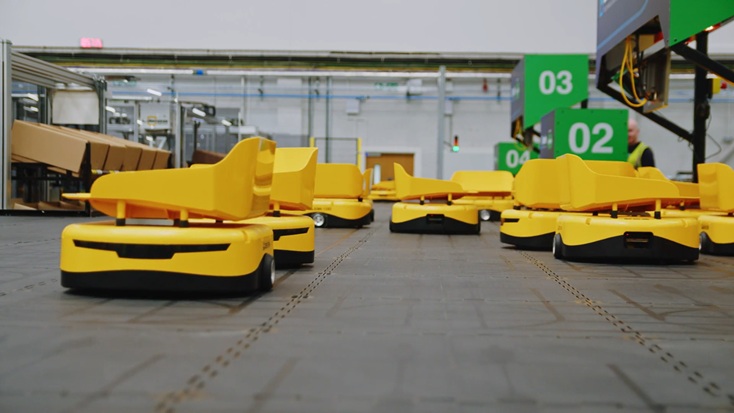
Working with Specsavers, we delivered Libiao Robotics’ T-Sort: a high-density robotic sortation system that delivers consistent throughput in a small footprint and has the potential to expand by adding robots and destinations rather than rebuilding the system. The investment matches the demand, with enough capacity for the current operation but scope to cope with higher volumes.
It’s also a good illustration of trend two. Sortation hardware on its own doesn’t deliver a despatch operation, the software that orchestrates it does. BreatheIQ, our high level software platform, includes a T-Sort emulator that allows users to test the impact of different scenarios before implementing them and was a key factor in a successful go live.day
And trend three is in there too. Three despatch operations consolidated into one, 40,000 to 45,000 orders sorted daily, with capacity to scale. Up to 50% less packaging waste with fit-to-size packaging, and right-first-time delivery to stores.
What this means in practice
Modular doesn’t just mean expandable; it means the system can be reconfigured to match growth. The software orchestration layer is what determines how much value you extract from the hardware. And the business case has to be built on the full definition of value: throughput, but also labour saved, orders not mis-shipped, packaging not bought, and using the data that shows it.
Our job is to understand all aspects of the customer’s needs, from the commercial context to the operational processes, then design and integrate the right solution around it. Being technology-agnostic is central to this, we’re not tied to any single manufacturer, so we can genuinely recommend what’s best for the customer.
Comments are closed.