



Walk into a busy distribution centre mid-shift and the pressure is tangible. Forklifts are moving constantly. Orders are stacking up. Supervisors are watching the clock. There is very little margin for friction.
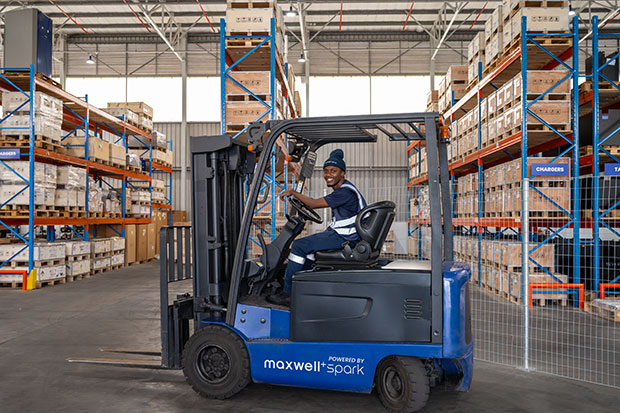
When something slows down, it is rarely dramatic. A forklift that feels sluggish halfway through the shift. A queue forming at the chargers. An operator waiting for a battery swap. A maintenance check that should have happened yesterday.
Forklift performance is usually judged on the truck itself — lift capacity, ergonomics and manoeuvrability. But on the warehouse floor, reliability is often determined by something less visible: the power system.
Telemetry data collected across maxwell+spark’s motive.li lithium-ion fleet — representing more than 13 million discharge hours — offers a grounded view of what “normal” looks like. On average, batteries are actively discharging for more than six hours per day. Charging accounts for a relatively small proportion of active time, often below 20 percent. In practice, this means charging is integrated into natural workflow pauses rather than dictating them.
For operators, that difference matters. When forklifts perform consistently from the first hour of the shift to the last, lift speeds remain stable and travel performance doesn’t fade. When charging happens during breaks rather than through planned battery swaps, trucks stay on the floor where they are needed.
Maintenance teams see the change too. Fewer routine interventions. No watering schedules. Fewer handling steps. Less time managing batteries and more time supporting the operation.
As an industrial lithium-ion manufacturer supplying material handling fleets, maxwell+spark has observed a shift in how operators think about power. Batteries are no longer treated as consumables that must be managed; they are increasingly viewed as long-term assets. Designed for extended service life, motive.li systems are engineered to deliver stable output across demanding duty cycles and, in many cases, to outlast the trucks they power.
Increasingly, that reliability is supported by data. Fleet-level telemetry provides visibility into duty cycles, charging behaviour and utilisation patterns, allowing operators to plan proactively rather than reactively. Power systems become measurable, manageable parts of the operation — not background variables.
In high-pressure warehouse environments, reliability is cumulative. It is built from thousands of small, uninterrupted actions. Forklifts, operators and layout all play their part, but without stable, predictable power beneath them, the rhythm falters.
Power strategy is no longer peripheral to fleet planning. In practical terms, a forklift fleet is only as reliable as its power source.
Comments are closed.