



Despite challenging economic conditions, the willingness to invest in intralogistics remains high. For Michael Ruchty, Exhibition Director of LogiMAT in Stuttgart, the renowned international trade show for intralogistics solutions and process management, there is no contradiction. “Crisis is the new normal,” he says. Companies need to make their processes more resilient while at the same time catching up on automation and digitalisation.
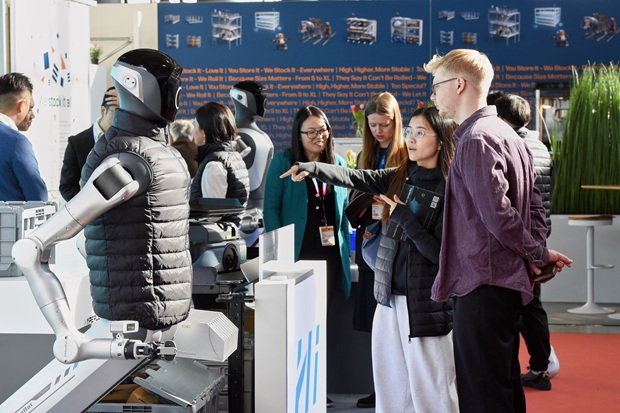 The most recent event demonstrated that the industry is not waiting for better times. More than 120 world and European premieres provided a comprehensive overview of the latest technologies and state-of-the-art solutions. According to Ruchty, one in three trade visitors comes to Stuttgart with specific investment plans, while more than a quarter place an order either at the show or immediately afterwards.
From the automated to the intelligent warehouse
Technological development has accelerated significantly in recent years. Advances in IT and sensor technology in particular have accelerated the practical deployment of automated guided vehicles (AGVs), drones and, increasingly, humanoid robotics.
Artificial intelligence plays a key role in this transformation. “AI has become ubiquitous in intralogistics.” It analyses and optimises process sequences and complex configurations. At the same time, previously separate technology fields are converging: autonomous transport systems and robotics are increasingly merging. Exhibition Director Michael Ruchty expects that, in the coming years, humanoid robots at LogiMAT will demonstrate how they can autonomously reach into bins in warehouse environments, relieving employees of monotonous picking tasks.
Transparency through integration
At the same time, requirements for transparency and traceability are increasing. RFID tags, intelligent labelling and identification systems, hardware components for material flows and the associated software can no longer be viewed as isolated solutions. What matters is their coordinated interaction. AI can analyse the information generated, increase transparency and further optimise processes.
The shortage of skilled labour is also accelerating this transformation. Advances in sensor technology are enabling increasingly safe collaboration between people and robots. Automation is therefore not only becoming a tool for greater efficiency; it is also changing how work is divided between humans and machines in the warehouse.
Drones count inventory, robots reach into bins
Michael Ruchty sees three key drivers shaping intralogistics in the years ahead: automation, digitalisation and the shortage of skilled labour. Advances in image recognition and sensor technology in particular are expected to further transform robotics and autonomous systems. Drones could increasingly take over inventory tasks in warehouses, while AI and software unlock additional optimisation potential and accelerate the development of new intelligent solutions.
LogiMAT in Stuttgart returns as a showcase for intralogistics
How quickly these visions are becoming reality will once again be on display in Stuttgart next year. From 16 to 18 March 2027, LogiMAT will bring together international suppliers and industry professionals at the Stuttgart Trade Fair Centre, directly adjacent to Stuttgart Airport.
According to the organiser, LogiMAT is the world’s largest trade show for intralogistics solutions and covers the entire process chain – from procurement and production through to delivery. International exhibitors will present technologies, products, systems and solutions designed to make material flows more efficient and optimise processes. The exhibition will be complemented by a varied programme of expert presentations and live events.
LogiMAT 2027 therefore offers an opportunity to explore key technologies of the future not in isolation, but as interconnected elements of tomorrow’s intralogistics: AI and software, autonomous systems, robotics, sensor technology and intelligent identification. Given the rapid pace of technological development, Stuttgart is once again set to provide a revealing snapshot of which solutions have already made the leap from vision to industrial reality.
Comments are closed.