



Retailers are not struggling with volume. They’re struggling with unpredictability.
One day it’s store replenishment. The next it’s an e-commerce peak. Add returns, tighter delivery promises and increasing SKU counts, and complexity quickly becomes the real bottleneck inside modern distribution centres.
The harder question is how to remain efficient when order profiles, customer expectations and business requirements are constantly changing? This challenge is becoming increasingly familiar across retail, e-commerce, parcel and third-party logistics operations. Success is no longer defined solely by throughput. It is defined by the ability to maintain operational control despite growing complexity.
A good example is the UK retailer Matalan.
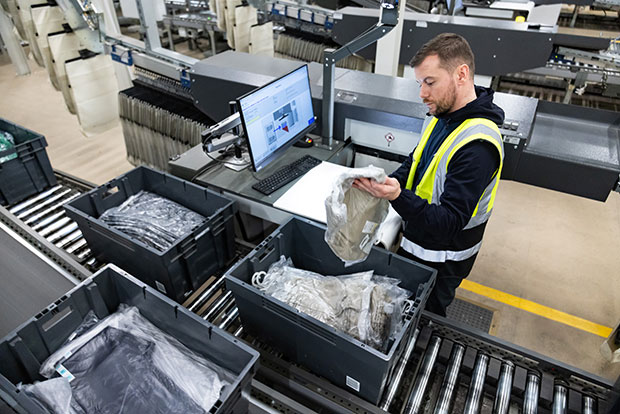
As one of the UK’s leading omnichannel fashion and homeware retailers, Matalan serves customers through a large store network alongside a growing e-commerce operation. To support that growth, the company chose a scalable automation strategy rather than a single large-scale transformation project. Together with DFT and the KNAPP Group, Matalan continuously expanded its automation landscape, starting with a DFT EcoPocket® sorter and later with a KNAPP Evo Shuttle™ as operational requirements evolved.
The results are impressive. According to published project information, Matalan achieved 99.8% order accuracy, improved fulfilment performance and extended next-day delivery order cut-off times by six hours. Supported by the combination of DFT sorting technology and KNAPP warehouse automation solutions, the operation is now capable of processing up to 100,000 orders per day.
What makes this case particularly relevant is not just the performance achieved, but the approach behind it.
Many logistics operations still view automation primarily as a way to increase throughput. Yet the reality facing supply chains today is far more complex. Retailers must balance store replenishment, e-commerce orders, returns processing and seasonal peaks, often within the same facility. At the same time, labour availability, operating costs and customer expectations continue to put pressure on operations.
In this environment, flexibility becomes just as important as capacity.
Businesses need infrastructure that can adapt as requirements change, rather than systems designed around a single set of assumptions. Scalability allows companies to respond to growth, support new business models and improve performance without disrupting daily operations.
The same principle is increasingly relevant beyond retail. Parcel operators are handling a more diverse mix of shipments. 3PLs must serve multiple customers with different service requirements. Distribution centres across industries are being asked to do more with existing resources.
The organisations that succeed will not necessarily be those with the biggest facilities or the fastest equipment. They will be the ones that can adapt most effectively to changing conditions.
That is why automation is evolving from a productivity tool into a strategic enabler of resilience.
The Matalan journey demonstrates how a scalable automation strategy, enabled by DFT and KNAPP, can help transform operational complexity into operational control. Rather than reacting to change, businesses gain the flexibility to absorb growth, maintain service levels and continuously improve performance.
As supply chains become more dynamic, a scalable automation strategy that can grow and adapt alongside the business may prove to be one of the most valuable competitive advantages of all.
Comments are closed.