


AI-Augmented Warehouse Execution: Making People, Technology and Operations More Adaptable
By Richard Rigden, Project Manager and Solutions Consultant
Distribution operations face persistent labour shortages, rising order complexity, tighter service expectations and ongoing pressure to control costs. Automation can help address those challenges. But the next phase of warehouse performance will not be defined by how many people can be removed from the operation. It will be defined by how effectively technology helps the people, systems and assets already in place adapt to constant change.
The Need for Adaptability
Most warehouses are not clean-sheet, fully automated environments. They are complex, mixed operations where people work alongside conveyors, mobile robots, lift trucks, legacy systems, paper-based processes and modern warehouse management platforms. Some zones may be highly automated while others remain manual. Some workflows are predictable while others shift by season, customer, order profile or labour availability. In that reality, the biggest performance gains often come not from replacing workers, but from giving them better direction, better information and more intelligent workflows.
Recent research underscores the point. In a Lucas Systems study conducted with Wakefield Research, 77% of supply chain executives said at least half of their warehouse systems are too rigid to meet operational needs, and 51% said their automation is not prepared to handle unforeseen change, new requirements or disruptions. Those findings highlight a broader industry issue: many automation strategies were designed for repeatability, while today’s operations require adaptability.
From Automation to Augmentation
AI-augmented execution offers a more practical path forward. Rather than treating automation as a one-time equipment investment, it uses software, data and optimisation logic to continuously improve how work is assigned, sequenced and completed. The worker still performs the task, but the system helps determine the best task to perform next, the most efficient path to take, the right priority to follow and the exception that needs attention.
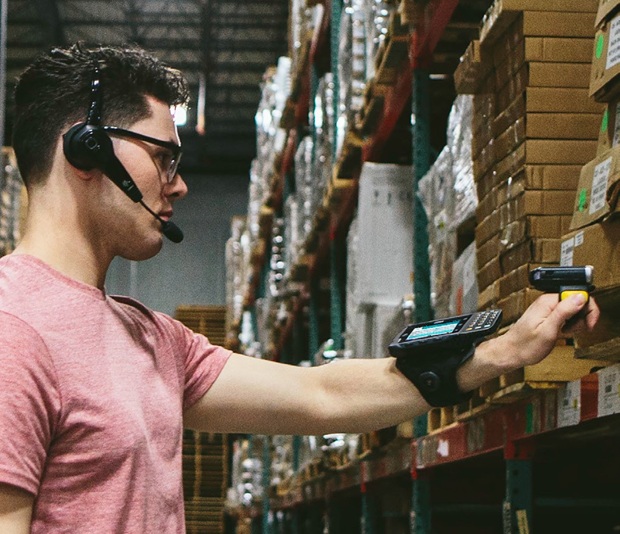
On the warehouse floor, this can take many forms. Voice-directed workflows, mobile applications, wearable devices and real-time task management tools can guide associates step by step while reducing reliance on paper, tribal knowledge and supervisor intervention. Optimisation engines can group orders, reduce travel, balance workloads and adjust task priorities as conditions change. When integrated with existing WMS, WES, robotics or material handling systems, these tools create a more responsive operating layer across both automated and manual processes.
Resilience Through Smarter Execution
The strategic value is not only productivity. It is resilience. In a rigid operation, a labour shortage, equipment outage, late inbound trailer or demand spike can quickly create bottlenecks. In an adaptive operation, priorities can be recalculated, work can be reassigned and managers can make decisions based on current conditions rather than yesterday’s plan. That flexibility is increasingly important as distribution networks become more volatile and customer expectations become less forgiving.
AI augmentation also changes the workforce equation. New employees can become productive faster when systems guide them through unfamiliar tasks. Experienced workers can spend less time navigating complexity and more time executing high-value work. Supervisors can shift from constant firefighting to proactive labour and workflow management. The goal is not to remove human judgement, but to support it with timely data and intelligent recommendations.
The Real Advantage
This is where the conversation around warehouse technology needs to evolve. Fixed automation remains valuable, especially in high-volume, stable processes. Robotics, conveyors and automated storage systems will continue to play an important role. But hardware alone cannot solve every operational challenge, particularly in facilities where demand patterns, labour availability and process requirements change frequently. Software-led execution gives operators a way to get more from existing infrastructure while building a foundation for future automation.
For warehouse leaders, the key question is no longer whether to automate. It is how to create an operating model that can flex. The most competitive warehouses will not be the ones that simply automate the most. They will be the ones that combine people, automation and intelligence in ways that make the entire operation more responsive. In an environment defined by uncertainty, the real advantage is not replacement. It is adaptability.
In his role as Project Manager and Solutions Consultant, Richard Rigden works with the Lucas Systems business development and operations teams in EMEA to identify software solutions for customers that optimise warehouse operations with transformational projects providing rapid ROI. Richard’s career across multiple business sectors within retail operations, supply chain, software project delivery and warehouse operations gives him a unique and comprehensive view of the challenges many businesses face in serving the expectations of their customers.
Comments are closed.