




The dramatic rise of e-commerce has contributed to the rapid evolution of the world of warehouse and logistics, but it isn’t by any means the only challenge UK warehouses have to face.
Swisslog’s intralogistics experts serve customers from all walks of life, particularly within the retail and ecommerce, pharmaceutical, automotive and food & beverage industries. As a proud member of the KUKA Group, Swisslog is investing heavily in its technology portfolio to help businesses around the world connect with the future.
James Sharples, Managing Director of Swisslog UK, spoke to Warehouse & Logistics News about the challenges impacting on warehouses, and how using tomorrow’s technology today can abolish these issues.
Warehouse & Logistics News – James, what do you see as the current major challenges for warehouses and distribution centres?
In the world of logistics, warehouse managers face many issues on a daily basis, but one that most distribution centres have experienced at one time or another is limited storage space. Whether steady business growth or an anticipated peak is responsible for this challenge, it is an obstacle nonetheless, and at Swisslog we have made it our aim to provide the tools to tackle it. Returns handling is another problem some retailers are eager to address. In addition, errors and system downtime can take a huge toll on businesses’ success and we have placed a lot of emphasis on error detection and other technologies designed to help managers predict how their warehouses will perform in the future.
WLN – How has the Swisslog portfolio evolved to tackle these challenges?
Over the past year, we have been incredibly busy strengthening each segment of our product portfolio to ensure there’s something to meet the needs of every business. With developments in automated mixed case pallet creation, pallet shuttle systems, automated item picking, and warehouse management software, we are well on track for shaping the future of intralogistics!
WLN – What is Swisslog doing to confront the issue of limited storage space?
Swisslog has a wide range of solutions available to accommodate those facing a lack of space in their facilities, but most recently we have upgraded our PowerStore compact pallet shuttle system for use in Europe. The solution is already being used with great success by some of our North American customers, including PepsiCo and Coca-Cola, but it now has compatibility with UK and Euro standard pallets. PowerStore is renowned for using virtually every square metre of the available space, and for Pepsi Bottling Ventures (PBV), PowerStore increased storage capacity by as much as 60%.
AutoStore, another solution from Swisslog, maximises warehouse space when storing by cases rather than pallet load, with the added benefit of fitting into the existing footprint of any building. ASDA selected AutoStore to handle a range of its products in a more space-efficient and productive way. An intelligent storage and retrieval system for small case lines, the solution provides ASDA with flexibility for its future expansion. The Lutterworth IDC is already one of the busiest depots in ASDA’s distribution network. The ability to reengineer the facility and build a space-efficient and ergonomic application was a key selection factor. The entire design and build was completed in a matter of months and incorporates over 70,000 storage bins and 223 robots, linking eight ergonomic decant stations with 15 goods-to-man picking ports.
WLN – Swisslog claims to have solutions available that allow your customers to predict errors before they happen. How does this work?
We recently announced the introduction of SynQ, the next generation of our proven warehouse management software platform, WM 6. Short for Synchronised Intelligence, it is much more than just a WMS – it connects and synchronises automation equipment, robotics, people and processes, all while collecting smart data on the operation. This data can then be analysed by managers to determine where there could be potential errors, and steps can be taken to rectify the fault before it has an impact on the operation.
WLN – What benefits can virtual reality bring to the logistics industry?
We are already bringing benefits to our customers by using augmented and virtual reality from the design stage through to supporting service maintenance. It goes way beyond visualising the scope of a new installation – the immersive systems allow customers to identify improvements and upgrades before any development takes place in the real world. It shows the end user the scale of their investment, and helps us to go the extra mile in ensuring the solution designed is right for them.
WLN – We’ve also heard a lot about augmented reality. Is Swisslog making use of this technology?
It’s fair to say that AR technology is now becoming an important tool, both in terms of maintaining levels of service and in designing new installations. Swisslog is optimising augmented reality benefits for minimal downtime and maximum availability of warehouse automation solutions. Using AR combined with our SynQ software platform, our customers can minimise maintenance engineers’ response times and ensure rapid access to skilled and trained technicians.
WLN – How would you advise ecommerce warehouse managers looking to handle peaks better within their supply chain?
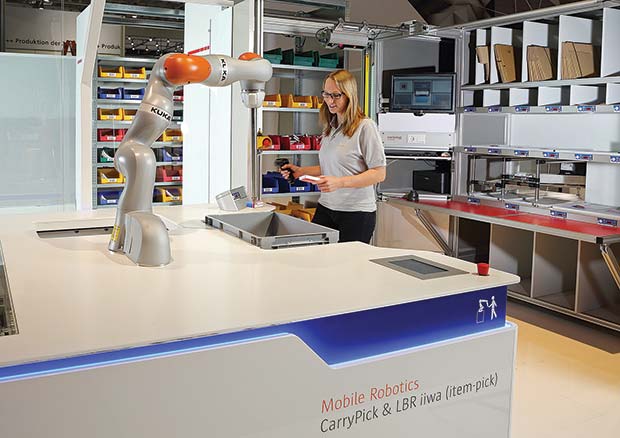
With the rise of e-commerce, we recognised a need for an automation solution to handle small order fulfilment, and consequently, our AutoPiQ solution was born. The solution design is based on a shared picking principle. The robot picks the items that he is able to pick – which can be up to 95% of the customer’s product range – and a worker finishes the order. The core of the solution is the portable robot cell (ItemPiQ), which was recently upgraded with a new innovative gripper. With four different gripping possibilities, the portable robot cell can collect up to 20% more products, when used with Swisslog parent company KUKA Group’s other technologies, than conventional industrial robots with typical suction grippers.
WLN – Would you say traditional retail warehouses have fewer solutions available to them now, due to the shift in focus to e-commerce?
Our efforts in small order fulfilment don’t mean we have left traditional retailers behind. We also recently debuted the ACPaQ solution, a fully automated mixed pallet creation system. While we had already installed many systems around the globe with fully automated mixedcarton picking and palletising, our collaboration with KUKA enabled us to provide an enhanced solution with improved technology.
Creating customised mixed pallets for individual stores from single-SKU pallets is one of the most important areas of successful retail warehouse operations, and has long been a monotonous manual task for retailers. We have addressed this challenge by unveiling a robot-based solution designed to fully automate and potentially triple the speed of the palletising process.
WLN – How are returns affecting retail and e-commerce distribution centres, and what do you think the solution is?
To compete in today’s market, retailers are offering free returns, but this can mean double logistics cost, no turnover and sometimes a disappointed customer. The solution is an efficient returns handling process, enabling a smooth experience for the consumer, accelerated availability of returned goods, lower intralogistics personnel costs and higher storage density.
WLN – What can Swisslog offer retail and e-commerce warehouses to solve the issue of returns?
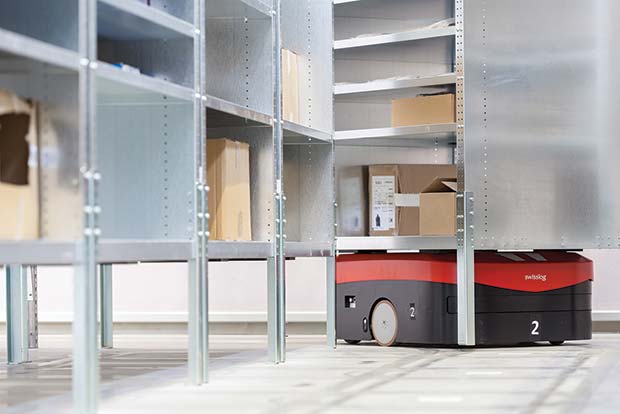
All the elements of the efficient returns handling solution I mentioned just now can be found in a range of Swisslog products, including CarryPick from our Click&Pick portfolio. With CarryPick’s mobile rack technology, returned items can be stored using random putaway and picked from first for fulfilling subsequent orders. Because of the use of random putaway, there is a higher chance of fulfilling multiple orders from a single pick and it is done smoothly and efficiently thanks to this technology.
WLN – Finally, do you feel there are companies who are still sceptical about automation’s potential, or has it now reached a higher level of acceptance among logisticians?
I think there are still some people who believe either that automation is only for certain sized companies or that it can’t cope with their specific circumstances, but overall we’ve seen a change in attitudes over the past few years. E-commerce has certainly played a part in raising the public’s consciousness and taking us to a new level, but the speed of technology innovation has also been a key factor. Perhaps before this people looked at stevedores and containerisation in the same way: we seem to be now in the middle of a similar process with more advanced robotics. Obviously we have a job to do to ensure logisticians see the commercial and practical benefits on offer, but the evidence is stacking up for all to see.
SWISSLOG UK
Tel: 01527 551 600
Comments are closed.