



Safety, efficiency, and sustainability are not mutually exclusive in warehouse operations. With the right planning and careful implementation, a warehouse can be both safe and efficient, while also reducing unnecessary energy waste.
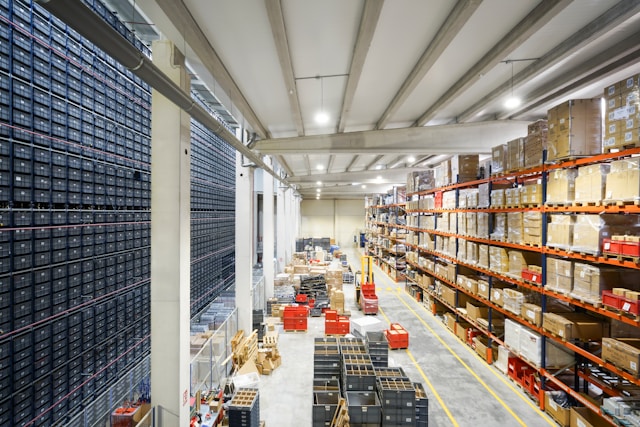
Safe Strategies for Optimizing Energy Use
According to official government statistics, industrial energy consumption in the UK is dropping thanks to an increased uptake of sustainable practices. The report notes that these changes result from “improvements in energy efficiency and a move away from traditional manufacturing”.
Some of the most impactful changes include:
- Switching to LED lights: Many UK warehouses were built years and even decades ago. As a result, they may use inefficient fluorescent or halogen lighting. By switching to LEDs, a warehouse could use up to 90% less energy, and as we’re talking about big spaces lit for most of the working day, those savings add up.
- Install smart sensors: Motion sensors can turn off lights when they’re not in use. They can also signal when heavy machinery has been left idle or when certain equipment is draining energy abnormally.
- Heating systems: HVLS fans can reduce heating requirements by forcing rising warm air back to the floor level, while smart HVAC controls can set thermostats around shift schedules and in response to external temperatures.
- Thermal insulation: Older warehouses lose a lot of heat through loading bays and poorly insulated exterior walls. By insulating roofs and walls and upgrading doors, operators can reduce energy loss during colder weather.
Maintaining High Safety Standards
Operational and energy efficiency should never come at the expense of safety. So, as the warehouse moves to more efficient and sustainable practices, it should implement regular risk assessments to identify potential hazards, control risks, and improve safety around loading bays, forklift transit zones, high-level storage racks, and other high-risk areas.
Warehouses can reduce forklift incidents by placing signs and physical barriers in transit areas and installing LED lights and mirrors near blind spots. Safety protocols also extend to the equipment itself.
By using electric forklifts instead of those powered by LPG or diesel, the warehouse can eliminate tailpipe exhaust emissions from forklift operations. Of course, the trade-off is that the warehouse also needs to consider charging infrastructure and battery handling/storage.
Checking shelves for damage or rust, keeping floors clean and exits clear, and training staff on proper safety protocols can also reduce the risk of workplace injuries.
Use Technology to Improve Energy Efficiency
Advances in AI have created many opportunities for UK businesses, and these extend from the sales room to the warehouse floor.
Warehouse management systems provide real-time visibility across the whole operation, while also automating simple tasks and directing staff to required areas. They can assist with fleet management, charging optimisation, energy monitoring, and equipment utilisation, helping to optimise warehouse energy usage.
While it’s important to embrace technological advances like barcode scanners and automated management tools, businesses should never forget that employees are the main focus. Operators should provide ongoing training and optimisation, all while keeping employees safe and happy.
With a few simple layout adjustments, the business can make life easier for those employees while also improving productivity:
- Slotting: Place high-demand items close to the dispatch area to speed up picking and packing.
- Build up, not out: Taller shelving units and specialist narrow-aisle equipment make better use of available space without expanding the building.
- Create a logical flow: Design the floor space to create a single, continuous flow of goods that improves efficiency and safety—fewer crossed paths and less backtracking.
- Provide clarity: A few changes in lighting and signage, as well as clearer labelling, could reduce employee hesitancy and confusion, thus speeding up the picking and packing process.
Conclusion: Improving All Areas of Warehouse Operations
UK warehouses are facing pressure from all sides. Sustainability regulations are forcing them to rethink their approach to energy, while rising costs mean they can’t afford to waste energy. Tight margins mean they have to be more productive, but at the same time, they must make life easier and safer for their employees.
It’s a juggling act, but implementing the practices highlighted above can help the warehouse become a safer, more productive, and more energy-efficient space, thus benefiting everyone from employees to owners.
Comments are closed.