



Manufacturers are under increasing pressure to expand production capacity, manage labour availability, control costs and respond quickly to changing market demands, all while ensuring uninterrupted operations. As a result, internal logistics is no longer simply a support function. It has become a strategic enabler of productivity, flexibility and long-term growth.
For many organisations considering automation, the challenge is not whether to invest, but how to do so with confidence.
This was the challenge facing Fronius, a global technology leader in welding systems, photovoltaic inverters and battery-charging solutions. At its production facility in Sattledt, Austria, the business wanted to optimise production supply, improve the efficiency of internal transport and build an operation capable of supporting future growth without sacrificing flexibility.
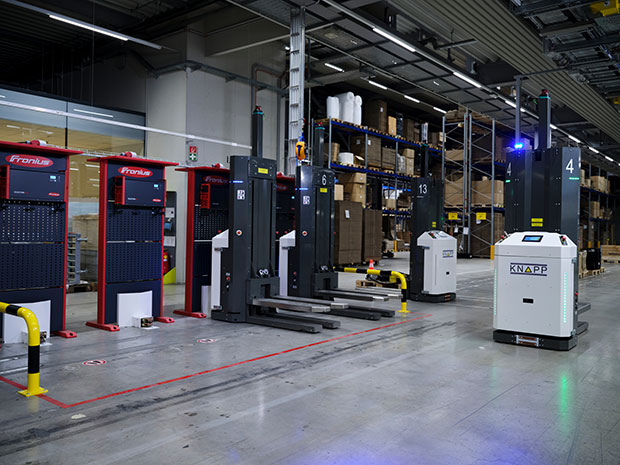
To achieve this, Fronius partnered with KNAPP to implement an intelligent automation solution centred around a fleet of autonomous mobile robots (AMRs). The deployment included 16 Open Shuttle Fork robots for pallet transport and 11 Open Shuttles for load handling, creating a fully connected material flow between goods-in, storage locations and production cells.
The result is a streamlined logistics operation that ensures materials are available precisely when and where they are needed, supporting production continuity while reducing manual transport requirements.
One of the biggest concerns for manufacturers investing in automation is future adaptability. Traditional automation systems can deliver efficiency but often require significant infrastructure changes and can be difficult to modify as production requirements evolve. Modern manufacturers need solutions that can grow and adapt alongside their business.
KNAPP’s Open Shuttle technology addresses this challenge by providing a flexible automation platform that requires minimal structural changes and operates safely alongside employees through intelligent navigation, obstacle detection and dynamic route planning.
For Fronius, this flexibility was a critical factor in the decision-making process: “We chose KNAPP because their system allows us a very high level of autonomy. The new automation system sets us up for making changes at our location independently, as well as being able to expand our production cells. This makes us faster and more cost-efficient in our overall operation than other systems,” said Peter Hubl, Team Leader for Logistics Automation Maintenance, Fronius.
This level of operational autonomy enables manufacturers to respond more quickly to changing demand, accommodate production expansion and introduce new processes without the disruption often associated with traditional automation projects.
Successful automation depends on more than moving materials from one location to another. Manufacturers need visibility, control and the ability to make operational changes without complex engineering intervention. At the centre of the Fronius solution is KNAPP’s KiSoft Fleet Control System (FCS), which provides centralised management of the entire robot fleet. The platform integrates directly with existing systems, coordinates transport orders, manages pallet movements and controls the timely delivery of materials to production areas. Importantly, KiSoft FCS enables Fronius to respond rapidly to production demands while maintaining overall system performance.
Real-time dashboards and monitoring tools also provide greater visibility of material flow, helping teams make informed decisions and continuously optimise operations.
While technology plays a key role in manufacturing transformation, the long-term success of automation projects ultimately depends on trust, collaboration and ongoing support.
Throughout the project, KNAPP worked closely with Fronius teams to design, implement and optimise the solution. Knowledge transfer and employee training formed an important part of the programme, enabling Fronius personnel to take ownership of system management and future developments.
Demand for technologies such as photovoltaic inverters, renewable energy infrastructure and advanced power management systems continues to grow as organisations invest in sustainability, energy security and production innovation. As markets evolve, manufacturers must be able to scale efficiently while maintaining the responsiveness needed to meet changing customer expectations.
The Fronius project highlights how intelligent automation, advanced software and a trusted partnership approach can help manufacturers achieve exactly that. It demonstrates how the right technology partner can help an organisation reduce operational risk, increase flexibility and build the confidence needed to support long-term growth.
For manufacturers looking to future-proof their operations, the greatest value may not come solely from automation itself, but from having a partner capable of delivering certainty in an increasingly uncertain world.
Comments are closed.