



The Cold Chain Federation (CCF) has today launched a new roadmap for decarbonising transport refrigeration across the UK, warning that years of government inaction have left the industry unable to meet its own targets for phasing out diesel-powered Transport Refrigeration Units (TRUs)
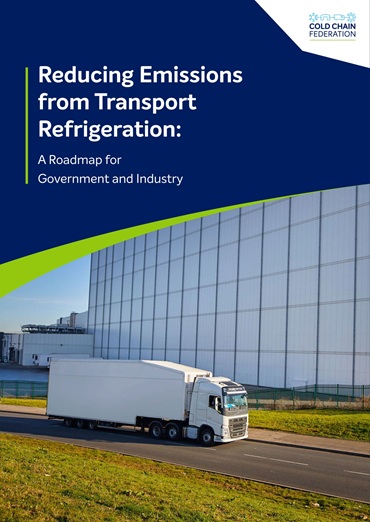 The report, Reducing Emissions from Transport Refrigeration: A Roadmap for Government and Industry, sets out a phased approach to accelerating the transition to zero-emission refrigeration, following growing frustration at the lack of Government leadership and targeted support.
Refrigerated transport forms a critical part of the UK’s food and pharmaceutical supply chains, and TRUs are responsible for keeping these products safe and secure as they move from producers and manufacturers to the end consumer. However, diesel-powered units remain a significant and often overlooked source of carbon emissions and air pollution.
In 2021, industry committed to ambitious targets to end the sale of new diesel-powered TRUs by the end of 2029 and remove diesel-powered units from UK roads by 2040. Since then, operators and manufacturers have invested in emissions reductions, improved operational efficiency and developed innovative TRU technologies.
Despite encouraging progress across the sector, the Department for Transport (DfT) has repeatedly failed to confirm who is responsible for TRU decarbonisation, while recommendations developed by their own funded research almost two years ago remain unpublished and unaddressed.
Tom Southall, deputy chief executive at the Cold Chain Federation says:
“Manufacturers and operators of transport refrigeration units have taken great strides in recent years to develop and implement low- and zero-emission alternatives to traditional diesel power. However, our research has shown that a complete lack of acknowledgement from the government of their efforts or support on challenges is hindering the speed of adoption and creating uncertainty on future policy direction.
“This new report is rightly critical of the government’s approach, however it also offers an olive branch and a chance for the government to come to the table and work with the cold chain industry to eliminate a significant source of carbon and air quality emissions once and for all”.
New CCF industry data highlights the disconnect between industry and government action, with a staggering 89% of operators either unsure about or believing there is no clear direction from the UK government on how and when TRUs will transition to lower- and zero-emission technologies.
Mat Owen, sustainability manager at FreshLinc says:
“Although transport refrigeration units consume considerably less energy than tractor units, our trailers remain in service for more than twice as long. Investment decisions therefore carry significant long-term implications, particularly when future technology and infrastructure remain uncertain.
“We need clear, consistent Government policy, supported by practical infrastructure development, to invest with confidence. FreshLinc is committed to reducing emissions, but the transition must be commercially viable and safeguard the integrity of the temperature-controlled food supply chain.”
The CCF is urging government to work with industry and turn the transition to zero-emission transport refrigeration into a major success story for UK transport decarbonisation. Without action, there is a risk that an opportunity to remove a significant source of carbon emissions and poor air quality will be missed.
The full report can be read and downloaded here.
Comments are closed.