



Latest ULTIMATE GREEN XT contains 93.5% sustainable materials and records a Bureau Veritas-verified product carbon footprint.
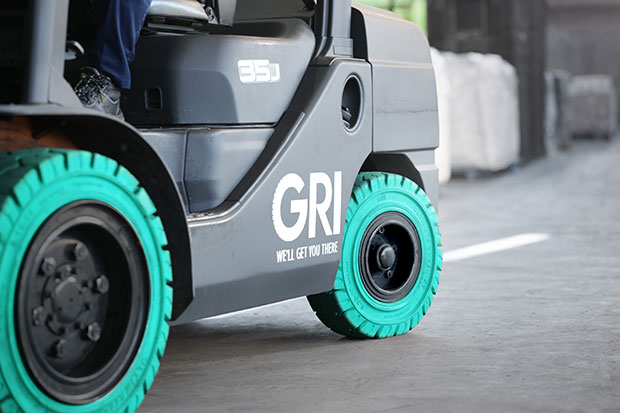
Global Rubber Industries (GRI) has further reduced the environmental footprint of its ULTIMATE GREEN XT solid tyre, with the latest version achieving a significantly lower product carbon footprint, as verified by Bureau Veritas.
The latest ULTIMATE GREEN XT delivers a 66.6% lower product carbon footprint compared with GRI’s conventional ULTIMATE XT, reinforcing GRI’s continued progress in developing more sustainable material handling tyre solutions.
GRI has also achieved an approximately 25% reduction in product carbon footprint compared with the previous generation of the ULTIMATE GREEN XT, while increasing the tyre’s sustainable material content to 93.5%.
The development reflects GRI’s approach of combining higher levels of sustainable materials with measurable reductions in product-level carbon emissions.
Moving Beyond Sustainable Material Content
Developed for intensive material handling applications, the ULTIMATE GREEN XT is designed for forklifts operating across warehouses, manufacturing facilities, distribution centres and other industrial environments. The tyre sits within GRI’s premium solid tyre portfolio and has been developed for both electric and internal-combustion forklift applications.
While sustainable material percentages have become an increasingly visible measure within tyre development, GRI has placed additional emphasis on quantifying the actual carbon footprint associated with the product. The figures provide fleet operators, distributors and industrial customers with measurable product-level data when evaluating the environmental impact of components used within their operations.
This is becoming increasingly relevant as companies look beyond vehicle emissions and energy consumption to examine carbon impacts throughout their equipment, procurement activities and supply chains.
Independent Verification
The product carbon footprint assessment has been independently verified by Bureau Veritas, an international testing, inspection and certification organisation.
Independent verification provides additional transparency around the environmental data associated with the ULTIMATE GREEN XT and supports customers seeking more robust information for sustainability reporting and responsible procurement.
The improvement also forms part of GRI’s wider work to reduce the environmental impact associated with tyre production through the development of sustainable materials, renewable energy initiatives and increasingly resource-efficient manufacturing processes.
GRI’s manufacturing operations are supported by certified management systems including ISO 9001 for Quality Management, ISO 14001 for Environmental Management and ISO 50001 for Energy Management.
Recognition Across the Material Handling Industry
GRI’s development of sustainable material handling tyres has also received international industry recognition.
At ProMat 2025 in Chicago, the company received the MHI Sustainability Award for its approach to sustainability within the material handling sector.
Later that year, GRI’s sustainable tyre technology received further recognition at Automechanika Dubai 2025, where the company was named Sustainable Product of the Year and received a Highly Commended distinction in the Innovative Product category.
The awards follow several years of development by GRI aimed at reducing the environmental impact of tyres used in industrial and material handling operations.
The Next Step in Lower-Carbon Material Handling
As manufacturers, logistics providers and fleet operators across Europe place greater emphasis on reducing emissions throughout their operations and supply chains, the environmental footprint of components such as tyres is becoming increasingly relevant.
For GRI, the latest ULTIMATE GREEN XT demonstrates how sustainable material development can be combined with measurable reductions in carbon impact.
With 93.5% sustainable material content, a 66.6% lower product carbon footprint than the conventional ULTIMATE XT, and an approximately 25% reduction compared with the previous ULTIMATE GREEN XT, the latest development further strengthens GRI’s focus on lower-carbon tire solutions for the material handling industry.
“Sustainability in tire development has to go beyond intent. It needs to be measurable, verifiable and capable of delivering real value in demanding applications.”
Comments are closed.