



A pallet of returned e-bike batteries arrives at the goods-in dock on an ordinary Tuesday. Most units look fine, but a couple have dented casings from transit, and nobody on shift is quite sure where they should go until someone checks them properly. That small, everyday moment is exactly where lithium battery risk enters a warehouse: not through dramatic failure, but through ordinary stock movements that get handled the same way as any other return. As battery volumes through logistics operations keep rising, more sites are rethinking where a damaged cell sits while it waits for inspection, and a growing number are turning to a purpose-built lithium battery storage container as part of that answer. This article sets out what drives the growing need for dedicated lithium-ion battery storage in warehouses and what compliance considerations operators should be aware of, covering fire risk, insurance expectations, the regulatory frameworks that typically apply, and how a workable storage policy actually gets built.
 TL;DR: Key Takeaways
- Battery returns and damaged cells carry a thermal runaway risk that ordinary pallet racking was never designed to manage.
- Insurers increasingly attach fire-protection conditions, such as separation distances and detection, to cover for sites holding batteries.
- COSHH and DSEAR can both be relevant to a battery storage area, covering chemical exposure and explosive atmosphere risk respectively.
- A dedicated lithium battery storage container offers a way to physically isolate damaged or suspect cells from general stock.
- A workable policy depends as much on staff training to spot damage early as on the storage infrastructure itself.
Why battery returns are becoming a warehouse fire risk
Battery returns are becoming a fire risk issue because the volume flowing through ordinary warehouse operations has grown far faster than most sites’ handling procedures have. E-bike packs, power-tool batteries, EV components and consumer electronics all now move through the same reverse-logistics channels as any other returned product, often arriving with no clear indication of their internal condition. A battery that looks intact from the outside can have a punctured cell, a swollen pouch, or internal damage from a drop during transit, none of which are visible on a quick goods-in check.
The mechanism behind the risk is thermal runaway: once a cell is damaged, internally shorted, or exposed to conditions outside its design range, a chemical reaction inside the cell can generate heat faster than it can dissipate. That heat accelerates the reaction further, and in a worst case the cell vents hot gas, ignites, or triggers neighbouring cells in a pack to follow the same path. This is why a battery that appears stable on arrival can still present a delayed risk hours or days later, which matters enormously for how long damaged stock sits unattended on a shelf.
For a warehouse manager, the practical implication is that batteries cannot be treated as a uniform category. A healthy, undamaged cell in its original packaging behaves very differently from a cracked or swollen one, and lumping both into the same storage approach is where risk tends to accumulate unnoticed.
Fire cover and insurance conditions for battery storage
Insurance cover is one of the main pressures pushing operators toward dedicated battery storage arrangements, separate from any building regulation. Insurers who underwrite warehouse fire risk have become more specific about what they expect to see where batteries are stored, because the failure mode of a lithium cell fire, rapid ignition, high heat output and the potential for reignition after apparent extinguishment, behaves differently from most other stored goods they are used to assessing.
In practice, this often shows up as conditions attached to a policy rather than a blanket refusal of cover. A common expectation is physical separation between battery storage and the rest of the racking, calculated so that a fire starting in one area has a reduced chance of spreading before it is detected or contained. Detection is the other recurring theme: insurers frequently want confirmation that a battery storage zone has monitoring appropriate to how quickly a thermal event can escalate, rather than relying on the same smoke detection spacing used across a general warehouse floor.
What this means for an operations manager is that insurance requirements and physical storage decisions are not separate conversations. A site that wants favourable terms on its fire cover needs to be able to describe, concretely, how battery stock is separated, monitored and controlled, and vague assurances about “keeping an eye on it” rarely satisfy an underwriter working through a renewal. The practical trade-off is that stricter separation and detection cost more to install, but a site that can point to concrete controls is generally in a stronger position when cover terms are reviewed.
COSHH or DSEAR: which rules govern your battery area?
Both COSHH and DSEAR can apply to a battery storage area, but they cover different parts of the risk. COSHH assessment principles are built around exposure to hazardous substances, which becomes relevant if a cell is breached and electrolyte or vented gas is released, since those materials can pose an inhalation or contact hazard to anyone nearby. DSEAR, by contrast, is concerned with explosive atmospheres, and a lithium cell venting gas under thermal stress can, in some circumstances, create conditions that fall within that scope.
The practical distinction matters because it changes what an assessment needs to look at. A COSHH-style review asks what substances could be released, in what quantity, and what controls (ventilation, PPE, spill response) would reduce exposure if that happened. A DSEAR-style review asks whether vented gases could accumulate to a concentration where ignition becomes a risk, and what controls, ventilation design, ignition source control, zoning, would reduce that risk. A site handling only small numbers of consumer batteries in sealed original packaging faces a very different picture from one processing bulk EV packs with visible casing damage.
Rather than treating these as two separate boxes to tick, most sites find it more useful to build a single risk picture that classifies battery stock by chemistry, damage state and quantity, and then checks which elements of each framework that classification actually triggers. Which rules apply in a specific case depends heavily on the detail of what is being stored and how, so a generic answer rarely holds across an entire site’s full battery inventory.
Quarantining damaged cells: dedicated containers or open shelving?
Damaged or defective batteries typically need to be kept physically separate from the rest of a warehouse’s stock, and the choice of how to do that has real consequences for how contained a fire risk stays if something does go wrong. Open shelving marked with warning tape is sometimes used as a stopgap, but it does little to limit heat, smoke or fire spread if a cell in quarantine actually fails, since the surrounding air and adjacent stock are not meaningfully separated from the damaged unit.
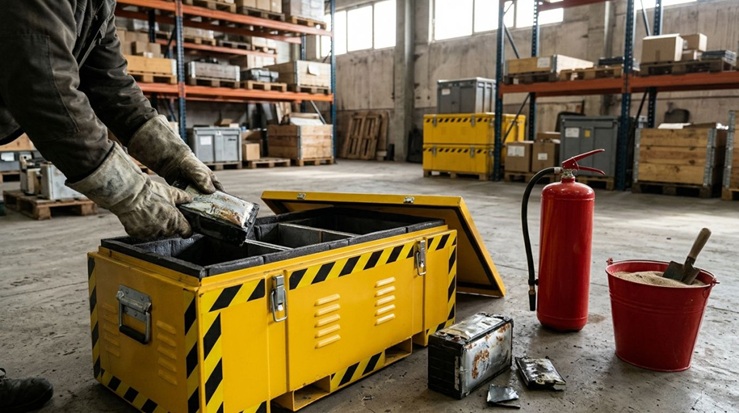
A dedicated enclosure changes that picture by design rather than by signage. Many sites address this by routing flagged units into a lithium ion Battery Storage Container built with fire-resistant construction and controlled venting, positioned away from general racking so that a failure inside the enclosure is far less likely to reach surrounding stock or structure. The trade-off is straightforward: a purpose-built container costs more than a tagged shelf section, but it buys containment that open shelving cannot offer, and that containment is usually what insurers and risk assessors are actually looking for when they ask how quarantine is managed.
Picture a facility that receives a weekly batch of returned power-tool batteries. A quick visual check at goods-in typically separates them into three rough groups: batteries with no visible damage that can go back into normal stock rotation after testing, batteries with ambiguous signs such as a scuff or a slightly swollen casing that need closer inspection, and batteries with obvious physical damage that go straight into quarantine without further handling. It is that third group, the clearly damaged units, where a dedicated enclosure earns its keep, because those are the cells most likely to be already progressing toward failure rather than simply suspect.
Drafting a workable battery storage policy
A workable battery storage policy starts with classification, not infrastructure. Before deciding what containers or storage zones are needed, a site has to define how it will sort incoming and returned batteries by damage state, by chemistry, and by how long they are likely to sit before being processed, tested, or shipped onward. A policy that only specifies where batteries go, without first defining how a unit gets assigned to a category, tends to break down the first time a borderline case shows up on the goods-in bench.
Staff training is the second pillar, and it carries more weight than it is often given credit for. A storage container can only contain what actually gets routed into it, and that depends entirely on someone at goods-in recognising the signs of damage in the first place: a casing that looks slightly swollen, a connector with discolouration, a pack that feels warmer than it should. Training that teaches staff what to look for, and gives them clear authority to pull a suspect unit without waiting for sign-off, reduces the chance that a damaged cell sits on general stock simply because nobody flagged it.
The last piece is review. A classification system that worked for a site handling mostly consumer electronics will not necessarily hold up once that same site starts taking in bulk EV returns, so the policy needs a built-in point for reassessing thresholds as the mix of stock changes. Treating the policy as a living document, rather than a one-off document signed off and filed away, is usually what separates sites that catch problems early from those that only discover a gap in their process after something has already gone wrong.
Comments are closed.