



From processing data to acting in the world
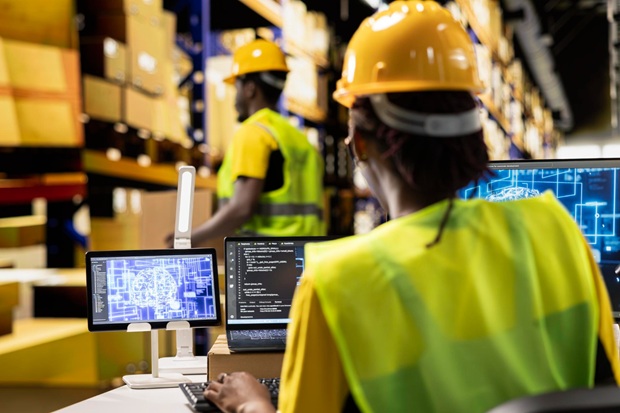 For most of the past decade, artificial intelligence in logistics has worked behind a screen. It has forecast demand, optimised delivery routes and slotted inventory, but it has never touched a parcel. Physical AI changes that. The term describes systems that do more than process information: they perceive their surroundings through cameras and sensors, reason about what they see, and act on real objects. A robot arm that identifies an unfamiliar item in a tote, works out how to hold it and places it in a box is physical AI at work. What these systems can do depends heavily on what they learn from, and that is why physical AI data has become a field in its own right. Specialist providers such as Physicl build the environments and objects these machines train on.
Learning in simulation, proving it on the floor
Teaching a robot entirely through real-world trial and error would be slow, expensive and sometimes dangerous. Most of the learning therefore happens in simulation. Systems train inside 3D environments that reproduce warehouses, shelving and conveyor lines, and they practise on virtual objects that carry real physical properties: mass, friction, the way a soft package deforms when gripped, or how a bottle shifts when it is tilted.
The quality of that simulated world decides whether the robot works once it leaves it. Engineers call this the “sim-to-real gap”. If a virtual cardboard box behaves more rigidly than a real one, or a plastic bag slides less than it does in reality, the robot learns the wrong lessons. It may grip too hard, misjudge weight or drop items it handled flawlessly in testing. Accurate physical properties, a wide variety of objects and realistic variation in lighting and placement all narrow that gap. In practice, a model is only as reliable as the world it was trained in.
What comes next for the warehouse
Warehouses are already a proving ground. AI-driven picking arms that handle mixed items, mobile robots that move goods between zones, and systems that unload irregular cartons from trailers have moved from pilot projects into live operations at a growing number of sites. What sets the newer systems apart is that they cope with variety. Older automation suited uniform, predictable tasks, while physical AI aims to handle the messy, constantly changing product mix of modern e-commerce.
The coming years raise more open questions. On work, the likeliest shift is in what people do rather than whether they are needed. Repetitive picking and heavy lifting may move to machines, while roles in supervision, maintenance and exception handling grow. How quickly that happens, and how well workers are retrained, will vary widely between companies.
On productivity, robots that adapt to new products without lengthy reprogramming could make automation viable for smaller operators, not only the largest distribution centres.
On safety, taking over strenuous and hazardous tasks could reduce injuries, provided machines that share space with people are designed and tested with the same rigour applied to their training data.
Physical AI will not transform the warehouse overnight. But as these systems learn to understand the physical world more accurately, the line between digital intelligence and physical work is starting to blur.
Comments are closed.