


For food manufacturers, wholesalers and food service operators, the question is no longer simply whether to automate. The greater opportunity is to connect automation, software and data to create operations that are resilient, scalable and ready for what comes next.
Food businesses operate in an environment where efficiency must coexist with speed, availability, freshness and service. For senior leaders making decisions about future operational capacity, that creates an important question: are we automating individual processes, or are we building an adaptable, scalable operation?
Automation can improve a process, but connected automation – underpinned by the right software and data architecture – can change how effectively the entire operation performs. That is increasingly where the strategic opportunity lies.
From warehouse project to business infrastructure
For food businesses, the connectivity between production, inventory and the customer can be particularly valuable. Products need to move quickly and accurately while operational requirements can vary significantly according to assortment, order profile, temperature regime and route to market.
The technology decision therefore cannot be separated from the wider operating model.
A recent example comes from Austrian dairy producer, NÖM AG. The company processes more than 1.5 million kilograms of milk every day and is expanding its logistics infrastructure with a new fully automated high-bay warehouse. Rather than looking at automation in isolation, NÖM is also creating an integrated SAP® environment spanning its logistics processes.
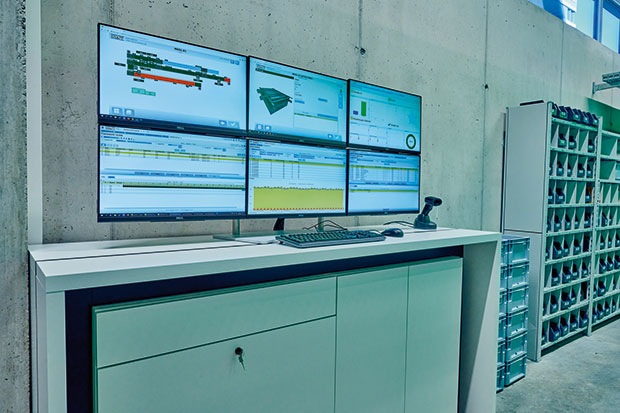
Before expanding its automated operation, NÖM evaluated whether its existing warehouse management and control environment could support its future requirements. SAP® EWM by KNAPP is subsequently being introduced across two locations, with the automated Baden site using SAP® EWM including a material flow system (MFS) to integrate warehouse management and machine control.
As businesses invest in automation, adding multiple technology layers and interfaces can create complexity rather than eliminate it. An end-to-end architecture can instead provide greater operational transparency while creating a platform capable of supporting future change.
By combining warehouse management and control within an integrated landscape, the solution can support environments ranging from manual operations to highly automated distribution centres.
For executives evaluating capital investment, that shifts the conversation from “What equipment do we need?” to “What operating capability do we need to create?”
Scale without unnecessary disruption
Transformation does not have to mean one high-risk changeover, as with NÖM, whose implementation has deliberately been phased. SAP® EWM was first introduced into the manual warehouse at Guntramsdorf before being extended to the more complex automated environment at Baden. KNAPP describes this phased approach as a way of allowing organisations to build expertise and system understanding while progressing towards more sophisticated automated operations.
Existing infrastructure, live production requirements and business continuity can make wholesale transformation impractical. A roadmap that allows automation and digitalisation to develop alongside the business can provide a more pragmatic route forward.
The executive question has changed
The compelling argument for intelligent intralogistics is therefore bigger than labour replacement or warehouse throughput, rather it is about creating an operation that can support growth, increase visibility, utilise resources more effectively and respond to changing customer and market requirements. For business directors and supply-chain leaders, this makes intralogistics a strategic conversation.
The businesses best prepared for the next decade may not be those that automate the most, but the ones which make the right automation, software and data decisions today, with tomorrow’s operation already in mind.
KNAPP is the reliable technology partner for intelligent value chain management. Headquartered in Austria, the KNAPP Group provides all-in-one solutions for automation and digitalisation, from production and distribution to the point of sale. Excellent service and long-term collaboration make KNAPP the strong partner behind the success of their customers in the sectors healthcare, retail and lifestyle, food retail, fashion, wholesale and manufacturing. Learn more at KNAPP.COM.
Comments are closed.