



As warehouse operations become increasingly automated and sustainability-driven, one challenge remains remarkably consistent: sooner or later, businesses run out of space. For many organisations, the immediate response is to relocate. However, with industrial property becoming increasingly expensive and suitable warehouse space often in short supply, moving is not always the most practical, economical or sustainable option.
Before committing to the expense and disruption of a move, it is worth asking a simple question: are you making full use of the building you already have?
In many cases, the answer is no.
Looking Beyond Floor Space
Warehouse capacity is often measured in square metres, but successful warehouse design is increasingly about making the most of cubic metres. While floor space quickly fills with racking, workstations, production areas and equipment, valuable space above frequently remains unused.
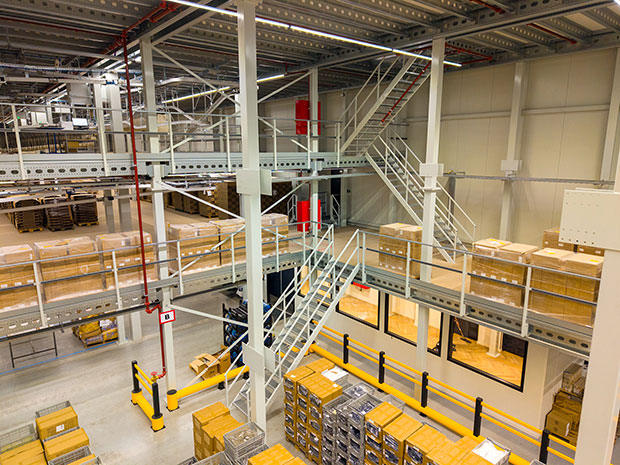
At John Scott Works, we regularly work with businesses that assume relocation is their only option, only to discover significant expansion potential within their current facility. Through bespoke cold-formed steel mezzanine floors, organisations can transform unused overhead space into productive operational areas.
Whether the requirement is additional storage, order picking, packing stations, manufacturing space, offices or conveyor support structures, expanding upwards can often deliver the capacity businesses need without the cost and disruption of moving premises.
The Real Cost of Relocation
Moving to a new warehouse involves far more than acquiring additional floor space.
Relocation often requires significant capital investment, lengthy planning and unavoidable operational disruption. Existing layouts must be redesigned, equipment relocated and employees adapted to a new working environment. Depending on the location, planning approvals, infrastructure upgrades and increased commuting distances may also become part of the equation.
Constructing a new warehouse requires significant quantities of materials, energy and resources, while existing buildings often contain unused capacity that can be unlocked through intelligent design.
Relocation does not necessarily solve future challenges. A warehouse that appears oversized today may quickly become constrained as product ranges, throughput and customer expectations continue to evolve. For many organisations, making better use of their existing warehouse provides a faster, more flexible and more sustainable route to growth.
Enabling More Efficient Warehouse Flow
As distribution centres continue to increase throughput, warehouse design is becoming less about storage and more about flow. The continued growth of e-commerce, increasing numbers of SKUs (Stock Keeping Units) and rising customer expectations are placing greater pressure on warehouse operations than ever before. Warehouses are expected to process more orders, store a wider product range and deliver faster, often without the opportunity to expand their existing footprint.
Modern mezzanine floors help organise operations across multiple levels, accommodating storage, picking, packing, quality control and conveyor systems while reducing ground-floor congestion and improving product flow. The result is not simply more space, but a smarter, safer and more productive warehouse.
Why Cold-Formed Steel Makes the Difference
The performance of any mezzanine floor begins with its structural design, and this is where cold-formed steel offers significant advantages.
At John Scott Works, mezzanine floors are manufactured using cold-formed steel profiles, combining strength, flexibility and sustainability. Compared with traditional structural steel, cold-formed sections require less material while maintaining excellent structural performance.
Their high strength-to-weight ratio also allows for longer spans with fewer columns, creating more open and usable space beneath the mezzanine. This gives businesses greater freedom when positioning racking, workstations, production equipment or conveyor systems, while keeping layouts flexible as operational needs evolve.
The result is a lightweight yet robust mezzanine structure that offers outstanding design flexibility, rapid installation and the ability to adapt to changing operational requirements. Precision manufacturing ensures consistent quality and long-term durability, allowing businesses to respond to future demands without fundamentally altering the building itself.
Building for Tomorrow
Warehouse requirements rarely remain static. Automation, robotics, conveyor systems and evolving fulfilment processes all demand facilities that can adapt over time.
A well-designed mezzanine floor can evolve alongside the business, supporting new technologies, changing workflows and future expansion without the need to relocate. This flexibility not only supports operational efficiency, but also helps businesses make better long-term use of their existing facilities.
Sustainability Through Smarter Use of Space
Sustainability is often associated with solar panels, LED lighting, electric forklifts and energy-efficient equipment. While these initiatives are undoubtedly important, making better use of existing buildings is equally valuable.
Creating additional capacity within an existing warehouse reduces the need for new construction and the resources associated with expansion. Cold-formed steel further supports these objectives through efficient material use, durability and recyclability, helping businesses reduce their environmental footprint while increasing operational efficiency.
Look Up Before You Move
As demand for warehouse space continues to grow, businesses are under increasing pressure to do more with the facilities they already have.
Relocating will always be the right solution for some organisations, but it should not be the first option simply because floor space appears to be running out. In many cases, substantial capacity already exists above the warehouse floor, waiting to be utilised.
Through bespoke cold-formed steel mezzanine floors, John Scott Works helps businesses unlock this hidden potential, creating additional capacity for storage, production, offices, conveyor systems and future growth without the disruption of relocation.
In an industry where every square metre counts, some of the most valuable space is often the space above your head.
Before investing in a larger warehouse, it may simply be time to look up.
Looking to maximise the space within your existing facility? John Scott Works designs, manufactures and installs bespoke cold-formed steel mezzanine floors that help businesses increase capacity, improve warehouse flow and prepare for future growth. Speak to our team to explore how your existing warehouse could deliver more than you think.
Comments are closed.