



Sustainable lighting is a hot topic in the world of warehousing. Involving far more than just energy efficiency and power consumption, for those organisations on the path to net zero, embodied carbon, product lifespan, repairability and circularity all need to be considered. Nick Gwilliam, Lighting Designer at Ansell Lighting, explains more.
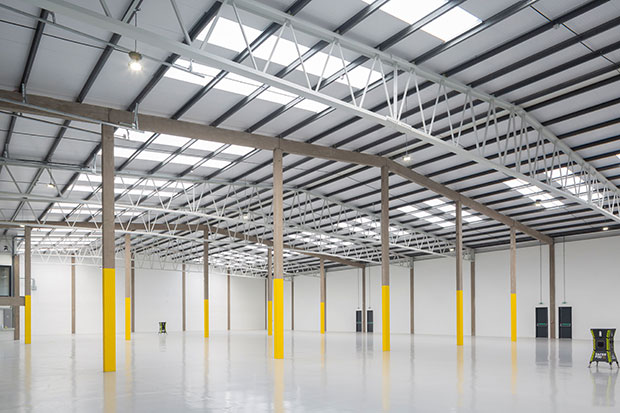
Whether constructing a brand-new warehouse or upgrading an existing facility, lighting plays a huge part in the overall environmental performance of a building. With many businesses now working towards ambitious net zero targets, lighting design and specification must take more into account than energy efficiency ratings and LED performance if it is to meet sustainability goals.
From product design and the materials used to manufacturing processes, maintenance requirements and end-of-life disposal, there are many different factors that contribute to the overall environmental impact of a lighting installation. As a result, the focus is shifting towards following the principles of a circular economy, keeping products and materials in use for as long as possible while reducing waste and the demand for new resources.
One of the most important circular economy principles to consider when it comes to specifying lighting is sustainable product design. Manufacturers are increasingly developing luminaires that are more durable and can be easily upgraded with modules and other accessories to enhance their functionality. This not only prolongs product life but also reduces waste and the environmental impact incurred by manufacturing new fittings. Products that incorporate recycled materials and can be recycled at the end of their life are also an important choice.
Repairability is another factor that should be carefully considered. True sustainability means moving away from a ‘replace and dispose’ mindset towards one of ‘repair and maintain’, opting for lighting solutions with replaceable components that can be used to repair products as required. Until recently, when fittings such as downlights stopped working, it would be necessary to replace the entire product, but sustainable design has meant that manufacturers have now started to introduce products with replaceable parts such as drivers and light engines that can be swapped in the event of a part failure, reducing unnecessary whole-product replacement and the use of added resources in the supply chain.
End-of-life disposal is another important factor to consider when specifying sustainable lighting. Opt for products whose components and other materials can be easily separated for recycling or reuse, reducing the amount of waste sent to landfill and reducing demand for new raw materials.
All of these factors contribute to embodied carbon, one of the most important measures of a product’s sustainability. Unlike operational carbon, which is generated during use, embodied carbon considers the wider environmental impact of a product throughout its life cycle and the emissions generated from raw material extraction, manufacturing, transportation, installation and end-of-life processing.
Embodied carbon information can usually be found on Environmental Product Declarations (EPDs) and other sustainability credentials. Typically, the lower a product’s embodied carbon, the lower its overall environmental impact is likely to be.
Of course, energy efficiency is an important part of the sustainability cycle and must be a key consideration when specifying or upgrading lighting systems. LED technology is still the most efficient source of lighting to use and adding smart control systems, occupancy sensors, daylight harvesting and automated dimming can further heighten energy savings and operational efficiency by helping to ensure lighting is only used when and where it is needed.
Finding products that are truly sustainable is becoming easier thanks to certifications and industry assessment frameworks. Products with TM66 Assured accreditation are certified as meeting stringent circular economy criteria and take factors such as material selection, repairability, upgradeability, disassembly and end-of-life management into account. Where possible, these products should be opted for, as they provide independent verification that a product has been designed with circular economy principles in mind.
Comments are closed.