



In an era defined by rising order volumes, tighter delivery windows and constant pressure on margins, warehouse efficiency has become a front-page issue for logistics and supply chain leaders. Across the industry, businesses are rethinking how they use space, manage inventory and move goods through their operations. One solution is gaining momentum, the widespread adoption of returnable and reusable transit packaging, specifically plastic containers, boxes and crates.
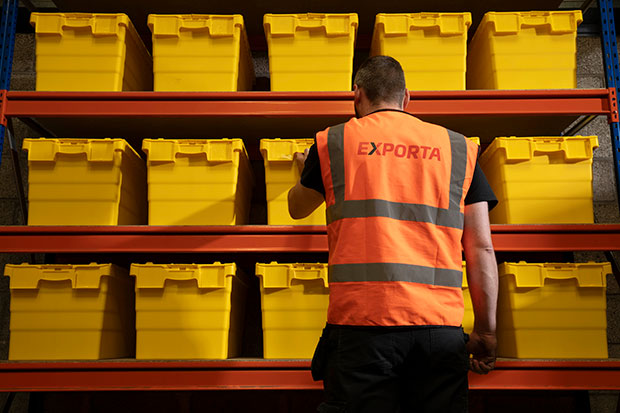
Far from being a simple storage upgrade, these containers are reshaping how modern warehouses operate. They are delivering measurable gains in space utilisation, productivity, safety and long-term cost control. Warehouse space has never been more valuable. Expanding facilities or relocating operations comes with significant financial and operational disruption, making better use of existing footprints a strategic priority. Inefficient storage systems often waste vertical space, create cluttered aisles and slow down daily operations.
Stackable crates directly address this challenge. Designed with reinforced corners and consistent dimensions, they allow goods to be stored safely and securely upwards rather than outwards. By maximising vertical storage, businesses can increase capacity without adding floor space, unlocking immediate efficiency gains within the same building.
One of the most significant advantages of stackable and nestable crates and containers is standardisation. When storage units are uniform in size and shape, warehouse layouts become easier to design and optimise. Racking systems, pallets and transport equipment can all be aligned around predictable dimensions, creating a more structured and navigable environment.
This standardisation improves stock visibility, reduces search time and supports faster picking and replenishment. In high-volume operations, these marginal improvements deliver meaningful productivity gains.
While full containers need to stack safely, empty containers present a different challenge. Left unmanaged, they consume valuable floor space, block walkways and contribute to operational congestion.
Nestable plastic containers are engineered to fit neatly inside one another when empty, dramatically reducing their storage footprint. This is particularly valuable during quieter periods, after dispatch cycles or in returnable transit systems where containers move back and forth between sites.
By keeping empty containers compact and organised, warehouses maintain clear aisles, safer working conditions and more flexible space for active operations.
Many modern container designs combine both stackable and nestable functionality. These dual-purpose containers stack securely when loaded and nest efficiently when empty, offering maximum flexibility in fast-moving environments.
For operations handling fluctuating volumes, such as e-commerce fulfilment, manufacturing supply chains or retail distribution, this adaptability is critical. Containers can scale with demand, supporting peak periods without creating storage headaches during quieter times.
Efficiency is not just about space, it’s about flow.
Standardised plastic containers contribute to smoother workflows by creating predictable storage locations and consistent handling processes. This leads to faster picking and packing, reduced handling time, improved picking accuracy and better compatibility with barcode and tracking systems.
When staff can identify, access and move stock easily, throughput increases and error rates fall, delivering direct operational and commercial benefits.
Unlike cardboard or timber alternatives, plastic containers and crates are designed for repeated use in demanding environments. They resist impact, moisture and general wear, maintaining structural integrity over long service lives.
Although the initial investment may be higher, the long-term economics are compelling. Reusable containers reduce replacement costs, minimise product damage and lower waste disposal expenses. Over time, they provide a strong return on investment while supporting sustainability goals through reduced single-use packaging.
As supply chains become more complex and customer expectations continue to rise, operational efficiency is no longer optional. Businesses that invest in smarter storage solutions gain a tangible competitive edge.
Plastic containers and crates offer a practical, scalable way to improve warehouse performance without major infrastructure changes. By optimising space, accelerating workflows, reducing costs and enhancing safety, they transform storage from a limitation into a strategic asset.
In today’s logistics landscape, the message is clear, warehouses that store smarter, move faster and operate safer will be the ones best positioned for long-term success.
At Exporta we go beyond the box.
We are on hand to support you with your container and crate project.
As a certified carbon neutral business, we understand that tangible sustainability gains are crucial for modern logistics businesses. Our range of containers and crates will help you move away from single-use solutions and provide you with a long term, reusable solution that can be recycled at the end of its working use.
Get in touch with our team today.
Exporta
t: 0800 294 4394
Comments are closed.