



Manufacturing downtime costs British manufacturers more than £180 billion a year due to lost productivity*. For warehouses in particular, it’s crucial to a business’ success and bottom line that their loading bays are fully operational at all times. This is why Hörmann UK has doubled its team of service engineers over the last year to ensure it provides both customers and non-customers with the highest standards in aftersales and servicing.
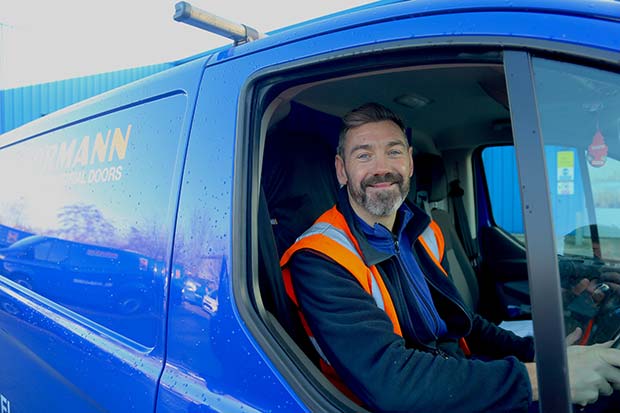
Here Matt Irons, Service Engineer for Hörmann UK, shares an insight into his day:
How long have you worked with Hörmann? I’ve been with the company for almost 16 years, having previously worked as a service and installations engineer for a Dutch loading bay company.
What is your job at Hörmann? I work as a Service Engineer and am part of a team of more than 20. What training was required?
At the beginning of my career I completed both a City and Guild course at college and a four-year electrical fitter’s apprenticeship. These courses gave me the knowledge and grounding to become a Service Engineer and my skillset has been enhanced further by Hörmann through regular training and development.
What does a normal day look like?
A typical day usually involves getting on the road early to avoid the traffic and making my way to site, which could be anywhere from Land’s End to John O’Groats. Upon arrival I will report to reception and meet the client to discuss the work, which may be a regular service or a necessary repair such as a door replacement.
A regular service, which is recommended at least twice a year, involves comprehensively analysing 30-40 different areas and components to ensure each area of the loading bay is functioning safety and correctly – which takes approximately 30 minutes to complete. Repairs are different and depending on the task at hand, it can take me as little as five minutes or a full day to complete.
What are the best and hardest parts of the job?
The best part of the job for me is travelling around the country meeting with new and existing customers and helping them directly. I also appreciate having the opportunity with Hörmann to be continually learning, as training courses are regularly being held. One of the hardest aspects of the job is having to meet strict deadlines on new sites, which can sometimes be out of our control due to unforeseen circumstances.
Have you worked on any interesting projects?
The most notable project for me has to be working on the Basketball arena and Olympic Village at the London 2012 Olympics. We were on-site for almost four months and it was great to be part of huge the team working together on such a historical event.
What has been your proudest moment at Hörmann?
I am proud to be part of the Hörmann exhibition team, which involves helping to prepare stands to showcase our industrial product range to new and existing clients at a variety of shows across the country.
This requires meeting strict deadlines and working efficiently with the team, but it is always a proud moment once completed. It was also very rewarding to take part in the 2014 Great North Run with a team from Hörmann. It was a gruelling challenge but we raised £2,000 for The Stroke Association, which was a fantastic achievement.
For warehousing operators, specifying the correct loading technology is vital to ensure operations are optimised at all times. However, the regular and adequate servicing of this technology is just as important to ensure site safety and overall productivity and should never be overlooked by the warehousing staff or the manufacturer of the loading technology. Hörmann UK’s servicing team is available to both existing and non-existing customers across the country to ensure systems are running safely, efficiently and securely.
For further information call 01530 516850 or visit: www.hormann.co.uk/industrycommerce- and-publicauthorities/ service.
*The Staggering Cost of Machine Downtime Report, Oneserve, 2017
HORMANN UK
Tel: 01530 516850
Comments are closed.