



Adam Smith, Managing Director, Association of Industrial Truck Trainers (AITT)

Whether for cost or convenience, many companies find that internal training delivers them the “best results”. But, how can they be certain without putting it to the test?
In-house training is an option for employers that can be perfectly viable when supported by proper monitoring.
However, we often find that it lacks accreditation from an awarding body. While this isn’t an exact legal requirement, we recommend it as best practice for five very important reasons.
- Gives your trainers the supervision they need
Without an external body’s standards to work to, there’s a real risk of instructors caving in to internal pressures to meet productivity and efficiency targets. This lack of proper supervision can result in the cutting of corners and this can significantly affect the quality and consistency of your training provision.
- Makes sure no important details are missed out
Typically, warehouse operator courses are split into basic training on equipment and practices (stage 1), followed by training on your organisation’s specific site and vehicles (stage 2).
If these stages are condensed or combined, internal instructors may save time and money in the short-run, but there’s a real risk of internal instructors missing out important details as a result.
Dedicated training companies, on the other hand, employ personnel with extensive industry experience and broad product knowledge of many vehicle types and applications — enabling them to provide a greater level of detail.
- Offers a strong foundation element
Another issue for employers to consider is the range of equipment utilised during training. If your operators are exclusively trained solely on the equipment used in their immediate environment, what will happen when they transfer to other sections or sites? For value and safety, it’s essential that your operators receive training that is widely applicable. (That’s why basic training is the qualification’s foundation element.)
- Allows you to train as and when necessary
It can be beneficial to have instructors on site, but internal trainers often carry additional roles, responsibilities and workloads. At peak times, such as the run-up to Christmas, this can mean a backlog of training requirements.
Because external training companies work on demand, they are available to offer you services as and when you need them.
- Encourages better cost efficiency
For many companies, training decisions often boil down to cost. However, we’ve found that outsourcing your requirements can be very cost-efficient — particularly for budget-conscious companies.
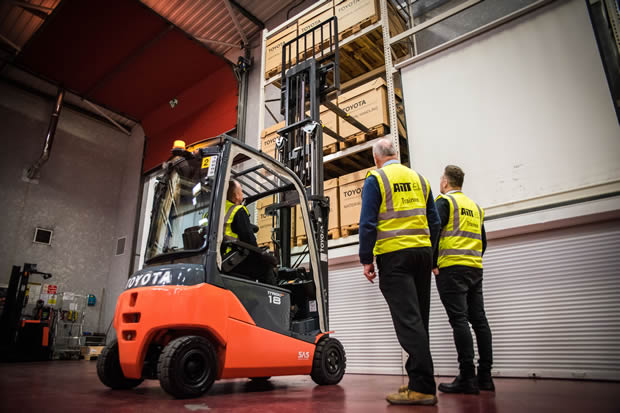
External training companies are effective at adapting training to your exact needs. This also means that you don’t need to pay for an in-house instructor all year round. After all, there will be periods where no training is really required.
For peace of mind, we can assess and audit the training being provided by your internal instructors to confirm whether they are meeting the correct standards based on industry-approved guidance.
Regardless of whether you use external or internal instructors, the most important thing is to make sure that they are accredited by an ABA training provider. It’s the one way to be certain that your training team achieves the necessary standards of quality and consistency. Plus, it means they are regularly updated on changes to the law and codes of practice.
To discuss your training needs, call AITT today on 01530 810867 or email enquires@aitt.co.uk.
Comments are closed.