



Retailer Xenos has grown considerably over recent years. The retail chain currently has around 300 stores throughout the Netherlands and Germany, but has plans to expand further. The company is aiming for 400 stores by 2020. In order to facilitate its plans, Xenos decided to extend its distribution centre (DC) in Waalwijk, the Netherlands. “The extension was necessary for us to stay at the forefront of one of the most competitive segments within the retail sector, and enable us to continue offering our customers a wide and varied range of products,” states Arthur Böhmer, Supply Chain Manager at Xenos.
 Böhmer explains the decision behind extending the DC: “We conducted a thorough distribution study and considered other locations. We also evaluated the German market and identified the greatest sales potential in central and southern Germany. We can replenish our stores in that area quickly and efficiently from Waalwijk so didn’t consider it necessary to move.” The DC in Waalwijk is also situated close to the port of Rotterdam. Products have been arriving via that port for years, and the supply chain manager regards it as a better option for Xenos than other ports.
To optimise the use of the space, Xenos went in search of a suitable automated solution. However, the decision to automate was not only prompted by the issue of space optimisation. Böhmer explains: “It’s becoming increasingly difficult to find good, motivated employees in this hotspot. We needed sufficient space to pick the orders based on the family grouping principle. If we don’t do that, our store employees spend too much time stocking shelves.”
THE SOLUTION
The right goods-to-man system combined with the stacking advice generated by the warehouse management system (WMS) would enable Xenos to continue with the family grouping method.
Böhmer found the right system at Swisslog, who in the role of main contractor took charge of the whole project. “We wanted a shuttle system because that was most closely aligned with our processes based on our capacity and assortment. The Swisslog solution not only offered the required capacity but also had the sorting system we wanted.”
Swisslog completed the new highbay warehouse in record time. With a height of 36 metres, it can hold 22,500 pallets which are stacked and retrieved quickly and efficiently using six Vectura pallet stacker cranes.
From the high-bay warehouse, the pallets are transported via a system of conveyors and lifts to four ProPick depalletising stations where employees repack the goods into order-specific trays. Once one layer of the pallet has been decanted, the pallet is automatically positioned at the correct ergonomic height to eliminate stretching or heavy lifting. During the repacking process, the items are weighed and checked.
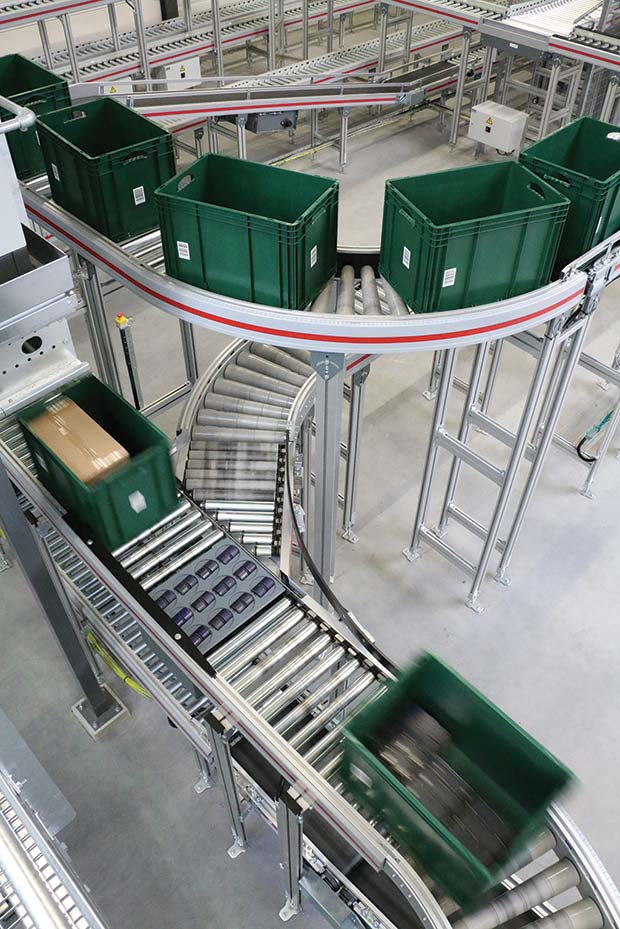
When full, the order-specific trays are transported by conveyor to the Swisslog SmartCarrier shuttle system. This comprises 11 lifts and 55 carriers, which distribute a total of 27,000 trays across 30,000 storage locations.
With a capacity of 2,500 trays per hour, the QuickMove conveyor supplied by Swisslog takes the trays from the SmartCarrier system to one of six picking stations. The trays are sorted in a loop system so the order lines arrive at the right station precisely in accordance with the predetermined stacking pattern. There, two clear touchscreens enable the picker to see exactly how many products must be placed where. The prepared goods are positioned on a metal base in line with the calculated stacking pattern. Once the order is complete, a lift transports it to the ground floor where the goods slide from the metal base onto a roll cage.
The biggest challenge during the project was to connect the software between the Centric Locus WMS and Swisslog’s warehouse control systems (WCS). The WMS not only generates stacking patterns but also determines factors such as replenishment strategy. “The Locus software can decide at any moment that items from the SmartCarrier system must go to the existing, manual pick operation or vice versa. If that runs flawlessly, you gain maximum efficiency from your processes,” states Böhmer.
The new operation facilitates further growth without requiring investment in extra employees. “That creates savings throughout the entire supply chain. At store level it saves three to four hours per delivery, per store, and the productivity has also increased,” asserts Böhmer. With the new system, each station can perform up to 500 picks per hour. Thanks to the two weight checks, the error percentage has decreased. “In fact, so far we’ve stayed completely error-free,” confirms the manager.
Comments are closed.