



Warehouse operations in the past involved intense manual labor. This changed with the introduction of machinery like conveyor belts, forklifts, and the like into the warehouse. Still, warehouse operations remained labor intensive. This is set to change with the rapid adoption of automation in warehouses.
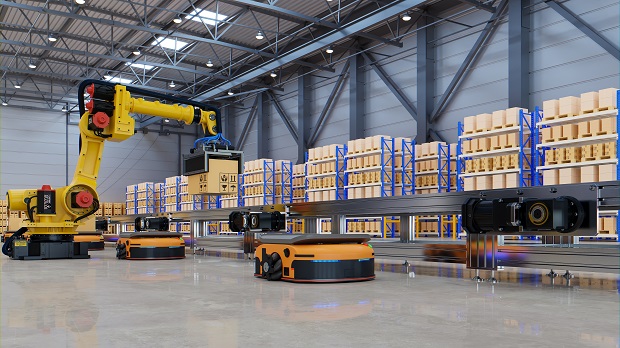 Image by vanitjan on Freepik
Warehouse robots
Automation in warehouses is possible with multiple autonomous robots. These robots perform specialized tasks within the warehouse, without human employees or alongside warehouse employees. Some of the popular robots used in warehouses are as follows:
- Picking robots: These are specially designed robotic arms that have the ability to pick specific products from warehouse shelves.
- Automated guided vehicles (AGV): AGVs are mobile robots that can transport inventory within a warehouse without any external guidance.
- Sorting robots: Robots that sort products from a collection. They are equipped with vision systems powered by artificial intelligence.
- Packing robots: Robots that pack picked products in packaging that is suitable for shipping the product.
- Automated storage and retrieval systems (AS/RS): AS/RS is a warehouse automation technology that automatically stores and retrieves inventory. These units use a system of carousels, shuttles, cranes, vertical lift modules (VLMs), etc., which store and retrieve inventory.
There are many more automated solutions used in warehouses, depending on the situation and the technology available. Warehouse robots are primarily used to automate labor-intensive processes. This relieves the dependence on the employees’ physical effort. These robots also help in improving the accuracy of warehouse operations. Most errors in warehouses are human errors and robots can help eliminate them.
Robots and employees
The trajectory of automation is can seem worrying for warehouse employees. Essentially, robots are performing tasks that were previously, for the most part, done by employees. Warehouse robots are displacing workers in warehouses. If you extrapolate this trend, human employees will be required only for warehouse maintenance, until robots take over that too. That is a grim picture.
But, that is an extreme take on reality. Automation in warehouses does not go from zero to a hundred quickly. It is an evolutionary process that spans over many years. The most likely roadmap warehouses will adopt is to use collaborative robots (cobots) before introducing completely automated solutions in the warehouse.
Cobots work alongside human employees to reduce the required physical effort. Cobots help to reduce the total distance employees have to walk within the warehouse facility. They also help to improve safety in warehouse operations. They bring down errors and make employees more productive.
Yes, cobots will be a step before warehouse operations are completely automated. Warehouse professions available today will cease to exist with the introduction of more warehouse robots. But this is not a doomsday scenario for people. Computers were accused of displacing people from different work environments; the trend played out over decades, and you can see that computers created more jobs than they destroyed.
It is highly likely that the increasing popularity of warehouse robots will follow the same trend. They could destroy some jobs in the warehouse industry. But the change will create more jobs in ways we cannot fathom right now.
The dispossessed…
Disruptive innovations destroy some jobs and create plenty of new opportunities. We have seen this trend over and over from the start of the industrial revolution to the IT revolution. That may seem like a net-positive impact on the job market. But what’s hidden in the change is that the people who lose jobs due to innovation are not the ones who get employed in the jobs created by that same innovation.
Disruptive innovations like warehouse robots will displace many employees who will not be gainfully employed again. According to data from the Bureau of Labor Statistics, there are 3.4 million warehouse workers in the United States. When such a large number of employees are dispossessed, this could lead to a huge societal problem.
Governments across the spectrum must realize the problem and implement appropriate interventions to prevent that. Reskilling and upskilling warehouse employees has to be done to empower them for the future labor market, after warehouse operations are taken over by robots. Warehouse operators should actively take steps to support that, and governments should be enacting policies to nudge them in the right direction. The tradeoff of doing nothing is an impending social disaster for millions of unemployed warehouse workers.
Bryan Christiansen

Bryan Christiansen is the founder and CEO of Limble CMMS. Limble is a modern, easy-to-use mobile CMMS software that takes the stress and chaos out of maintenance by helping managers organize, automate, and streamline their maintenance operations.
Comments are closed.