



For years, companies in discrete manufacturing, warehousing and e-commerce have spent millions on optimizing global supply-chains. Raw materials, pre-configured components or ready-made consumer products arrive at warehouse gates and intralogistics facilities at a meticulously timed pace. But then, hell breaks loose.
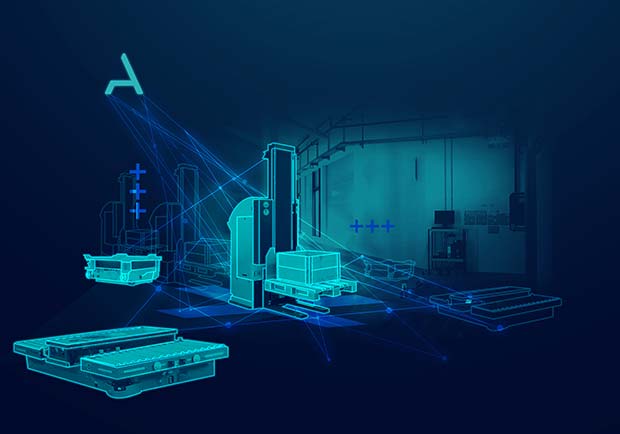 The perceived chaos on the shop floor stems from a mix of transport vehicles that lacks orchestration. From forklifts driven by workers to transportation robots – or Automated Guided Vehicles (AGV, for short) – the means of transport are diverse, and the task of coordinating them all is complex. As a result, logistics managers experience cumbersome planning processes, repeat accidents and expensive down-times.
What if a manufacturing company or an e-commerce hub had a software solution that could orchestrate hundreds, if not thousands of vehicles all from one dashboard, just like a master conductor? It would know – in real-time – the exact location and destination of each vehicle, adapting their workload and route to an ever-changing environment without human intervention. Also, it could integrate any AGV featuring the new industry standard data interface VDA 5050, regardless of the hardware vendor.
Now, meet SYNA.OS LOGISTICS, the holistic intralogistics operating system developed by SYNAOS, a German software-company founded by ex-Volkswagen IT and logistics experts. It was conceived as a hardware-agnostic software system that lives in the cloud and creates an overarching command and control layer for all AGVs.
Efficiency gains on the shopfloor
The key to SYNA.OS LOGISTICS’ power lies in the computing power of the cloud and the speed of its AI algorithms. They can process thousands of data points such as location, velocity, source and destination of transport, and more from hundreds of AGVs simultaneously. For each vehicle, an ideal route is calculated by the software in real-time, allowing for constant optimization, while accommodating for unexpected changes like human intervention or mechanical error in a split second.
This results in immediate efficiency gains for the logistics operation. Not only does it avoid collisions on the shopfloor and thus contribute to synchronizing just-in-time production lines, SYNA.OS LOGISTICS will ultimately reduce the number of robots required for a given floor plan. “Digital-twin”-type simulations of SYNAOS customers’ processes showed that 60 percent fewer delays in delivery of parts to a manufacturing line are possible, while significantly lowering the number of vehicles used overall. In turn, that resulted in 30 percent cost savings compared to a conventional plan. Now that sounds like the future of intralogistics, doesn’t it?
Comments are closed.