



Multi-client fulfilment brings together processes with very different requirements. B2C orders need to be sorted and sequenced efficiently, while B2B orders often require larger quantities to be consolidated for store replenishment. For logistics service providers in particular, the challenge is not simply to process more orders, but to manage very different customers, products and channels efficiently within the same operation.
Growth, Complexity and Channel Diversity
This was exactly the situation facing Dutch logistics service provider Modexpress. Serving brands including Suitsupply, Scapino and PSV Eindhoven, the company handles a broad product spectrum ranging from fashion and accessories to cosmetics. At the same time, its order structures were changing. Smaller e-commerce orders were increasing, while different sales channels required very different processes, from rapid sequencing for B2C orders to consolidated batches for B2B store replenishment. Traditional, largely manual processes based on put-to-light sorting and downstream packing stations were increasingly reaching their limits.
The key question was therefore bigger than simply how to automate individual processes: How can small online orders and large B2B batches be handled efficiently within one material flow while serving several customer environments in parallel?
One System at the Heart of Fulfilment
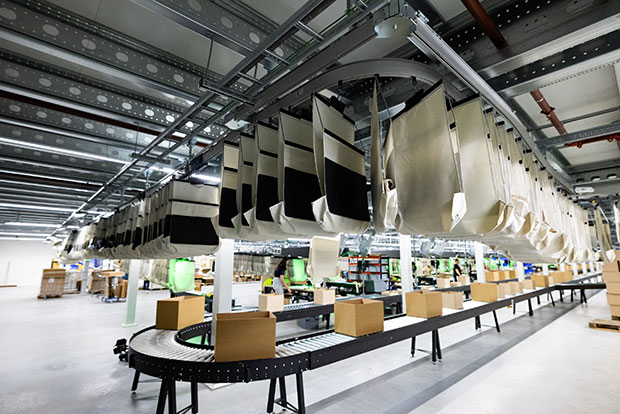
Together with DFT, Modexpress developed its answer around the EcoPocket® solution. The pocket sorter became the central element of a redesigned intralogistics concept at the Helmond site. Rather than adding another isolated automation component, the entire logistics structure was designed around the pocket sorter.
At its core is the ability to combine processes that traditionally place very different demands on a fulfilment system. Different brands and customers can be processed in parallel, while B2B and B2C workflows operate within one continuous process. Intelligent sorting and sequencing prepares items according to the respective order, customer, sales channel or subsequent process. Manual and semi-automated induction stations provide additional flexibility for varying products and packaging requirements.
Completed shipments can also be transferred directly into outbound logistics via an integrated packing machine, while real-time process visualisation provides operations teams with greater transparency.
From Sorting to an End-to-End Process
For Modexpress, this integrated approach has changed the way sorting and packing interact. Intelligent item consolidation before packing has substantially increased packing speed, while customer- and channel-specific requirements can now be managed within one system. B2C shipments reach packing stations in the required order, while B2B bundles are automatically consolidated.
The project also represents a milestone for DFT: the EcoPocket® installation at Modexpress is the company’s 100th installed adapter system, highlighting the maturity of the technology.
Why Intelligent Automation Matters
However the broader significance goes beyond a single installation. Pocket sorter technology is increasingly taking on a central role in fulfilment operations, connecting item-level control, sorting, sequencing and packing into an integrated material flow. For multi-client logistics providers, this creates a foundation for greater flexibility and scalability as e-commerce volumes and process complexity continue to grow.
The Modexpress project demonstrates an important principle for the future of intralogistics: automation alone is no longer enough. The decisive factor is how intelligently individual processes are connected and controlled as one system.
Comments are closed.