



For UK manufacturers looking to futureproof their operations, increase productivity and mitigate labour shortages, automation offers significant opportunities. Yet, for companies that have never introduced automation, the prospect may seem daunting. Overly ambitious designs, unnecessary complexity and high upfront costs can quickly put investment plans on hold, writes Dan Fisher, Head of Sales at FANUC UK.
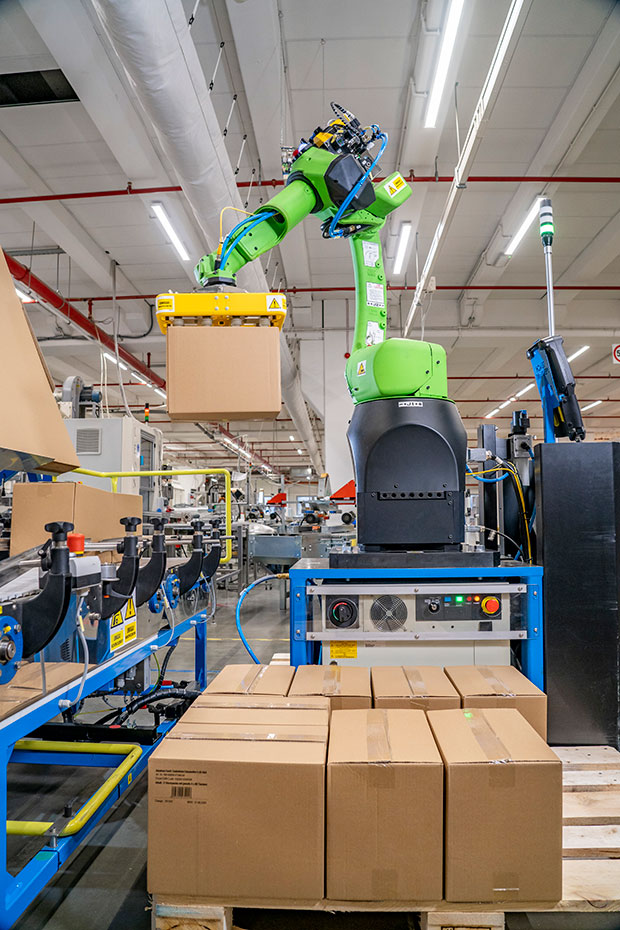 But taking the first step towards an automated factory does not have to be complicated. One often overlooked strategy is to start at the end of the production line and work backwards, beginning with one of the most straightforward and repeatable processes in manufacturing: packaging.
Whether producing sandwiches, door handles or automotive components, almost every manufactured product needs to be packaged before leaving the factory. In many cases, that means handling standardised cardboard boxes. The closer a process gets to the individual product itself, the more complex automation can become. Boxes, by comparison, are predictable and relatively easy for robots to handle.
Despite its importance, packaging is often overlooked when manufacturers consider where to introduce automation. Investment discussions frequently focus on complex pick-and-place applications at the beginning of the production line, where products can vary considerably in shape, size and handling requirements.
A more effective approach for first-time automation users is to focus on the packaging hall. Repetitive tasks such as box handling, case packing, palletising and wrapping can often be automated with comparatively little disruption to existing operations.
Robots are particularly well suited to dull, dirty and dangerous tasks. Lifting heavy boxes and stacking them onto pallets for an entire shift is repetitive, physically demanding and can place considerable strain on employees. Automating these activities can not only increase throughput, improve consistency and reduce bottlenecks at the end of the production line, but it can also ease the physical demands placed on employees and potentially lower the risk of handling-related injuries.
Staff can then be redeployed into more skilled, value-added roles, including quality control, machine supervision, maintenance and production improvement. This approach can also support workforce retention. Giving employees opportunities to develop new skills and move away from monotonous tasks improves job satisfaction, while reducing the time and expense associated with recruitment, onboarding and training.
However, although simpler than many other manufacturing processes, packaging lines typically combine several processes, including case erecting, product packing, box sealing, conveying, palletising and stretch wrapping.
Manufacturers should therefore look for an automation partner with established relationships across the wider packaging supply chain. Proven collaboration between robot suppliers such as FANUC and our system integrator partner network, who are providers of conveyors, box erectors, tape sealers and stretch wrappers, will help ensure that equipment works together as a cohesive system, reducing integration risks and supporting a competitive overall solution.
Collaboration is particularly important when businesses are considering changes to packaging materials. Consumer demand for recyclable packaging and ongoing legislative pressure is encouraging manufacturers to rethink the materials they use, and these changes create an opportunity to review production processes at the same time.
By considering automation alongside packaging redesign, manufacturers can address these challenges before new materials are introduced at scale. Packaging consultants and material suppliers should therefore aim to work closely with automation providers from the outset, reducing the need for costly modifications later on and reducing the change burden.
In conclusion, for any manufacturer that has yet to embrace automation, transforming an entire factory may feel overwhelming. Packaging provides a more accessible starting point, with repetitive processes and established robotic solutions offering opportunities for practical, measurable improvements.
By starting at the end of the production line, firms can build internal expertise, improve productivity and develop a clearer understanding of how automation can support their wider business objectives. The key is to define the operational challenge, assess the potential return and involve the right technology partners from the outset.
Automation does not have to begin with the most complex process in the factory. For many companies, starting with packaging could be the most effective way to improve efficiency, support the workforce, respond to sustainability demands and compete more confidently in a global market.
Comments are closed.