



Tom Leeming, Director, Tritax Big Box Developments, Warehouse & Logistics News
E-commerce has permanently changed what customers expect from delivery speed. That shift, together with fleet electrification, next-generation automation and tightening sustainability obligations is reshaping what a distribution centre needs to achieve for occupiers.
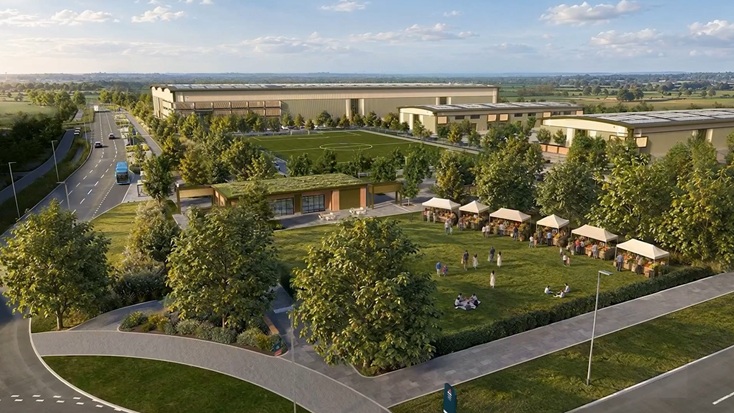 So, what does this mean for logistics operators looking to future-proof their business? It means making sure the building works for where the business needs to be in 2029/2030 and well beyond. Whether that’s adapting an existing site or securing a new one, it is a crucial business decision that takes careful planning to find the right long-term solution. For those whose future needs point to something new, that kind of bespoke, build-to-suit (BTS) approach takes longer to deliver than most businesses expect.
The timeline most businesses underestimate
A bespoke, BTS logistics building typically takes three to four years from initial brief to operational handover. Securing the right site, one with the location, power supply, labour catchment and road infrastructure to genuinely support the operation for the next 20+ years, takes time, especially as suitable land in key logistics corridors is increasingly constrained. Getting that right depends on how early a relationship with a developer starts, not just how good the site is. A developer working across multiple bespoke schemes is often better placed to flag requirements an occupier hasn’t yet had reason to think about, whether that’s future power capacity, automation-ready specification, or room to expand, well before those become expensive problems to solve later.
Then there is planning, which has become markedly more complex for large-scale industrial development. Shifting policy and closer scrutiny of large sites mean consent can no longer be relied on to happen quickly. Even a well-prepared application through a supportive authority can take months, and delays, appeals or legal challenges are a real risk on larger schemes.
Once planning is in place, construction of a large-scale distribution centre typically takes 12 to 18 months depending on scale and specification. Factor in mobilisation, infrastructure and highways works, fit out and commissioning, and the whole process needs to start today to be operational within three to four years.
Siemens Healthineers’ c. £250m delivery at Tritax Park Oxford shows what that early dialogue can achieve. Siemens spent years in collaboration with us from as far back as 2020, refining the requirements for its highly bespoke MRI magnet production and R&D facility, before the scheme moved into the typical three-to-four-year development process; the facility is now commencing occupation, ready to ramp up production into 2027 and beyond. That early groundwork is what let a project of this scale and specification get built right, rather than simply built fast.
What forward-thinking occupiers are doing differently
The logistics businesses getting ahead share one characteristic: they treat their property strategy as a long-term infrastructure decision, not a reactive one.
In practice, that means getting into dialogue with developers early and being open to conversations about sites that may not be immediately obvious but offer genuine long-term operational advantage. It is vital to understand that the process of working through a bespoke pre-let is not just about securing a building. It is about shaping every aspect of how that building, and the wider supply chain and network it supports, works for your business.
The best pre-let relationships are genuinely collaborative. Occupiers who engage early get to influence everything from site selection and design specification to bespoke layouts reflecting both their current operational requirements and the ones they haven’t yet identified, thereby driving efficiency and avoiding costly changes further down the line.
The supply picture makes this more urgent, not less
It would be convenient to assume that waiting will bring more options. However, the market is not currently telling that story. Speculative development is down from a recent peak that was itself low by historic standards, and the sites that have been brought forward in most cases have been let relatively quickly. Meanwhile, planning constraints are not easing, and although build costs have stabilised year on year, they remain elevated against the pre-2020 baseline in a more inflationary macro environment.
For occupiers in sectors like grocery and food, where operational continuity is non-negotiable, banking on a spec unit that matches their exact location and size requirements being available when they need it is an increasingly risky strategy. The bespoke pre-let route requires vision, forward planning, patience and early commitment, but it delivers the certainty of a future-proofed building designed around your operation.
If you are a logistics director reading this with a sense that your current building will not serve you for another five years, the message is clear: start that conversation now.
Tom Leeming is a Director at Tritax Big Box Developments, specialising in the development of speculative, pre-let and bespoke logistics development across the UK.
Comments are closed.