



The UK’s fertiliser supply chain has changed significantly in recent years. When CF Industries closed its Ince plant in Cheshire in June 2022 and ended ammonia production at its Billingham complex on Teesside the following year, the country lost the bulk of its domestic ammonia production in under two years. With rising gas prices making production unviable, the plants that fed Britain’s farms for decades went quiet, writes David Huck, Chief Operating Officer at Peel Ports Group.
The demand, though, didn’t go anywhere. Urea is the most concentrated solid nitrogen fertiliser on the market, and there’s no easy substitute for farmers. Now, the tonnage that once came off a production line in Teesside, comes off a ship. UK urea imports rose from 1.38 million tonnes in 2023 to 1.65 million tonnes in 2025. Total fertiliser imports reached around four million tonnes last year, representing a structural change that won’t be reversing while gas prices stay high.
Historically, import flows have naturally favoured locations with strong access to major agricultural markets and established transport networks. On top of this, there was also a freight logic, with a large share of urea traditionally moved from Russia through the Baltic, routed via Finland, making an east-facing port the shorter passage.
Location remains important, but the changing supply chain creates an opportunity to look more closely at the balance of warehousing capacity across the UK. For suppliers serving agricultural markets in the west and north, positioning product closer to those customers can reduce inland transport distances, improve resilience and provide greater flexibility when demand or import flows change.
Importers are now chasing volumes they can’t find in Europe, with more urea arriving from Algeria, Egypt and Nigeria. Egypt’s exports to the UK have climbed steeply since 2022, Algeria has surged and Nigeria has arrived as a serious exporter on the back of Dangote’s complex near Lagos, the largest granulated-urea plant in Africa. Russia, long a mainstay, has receded, and UK import duties on Russian urea are set to climb to 35% from July 2027, pushing buyers further towards North and West African supply.
The forthcoming carbon border adjustment mechanism, launching on 1 January 2027, sharpens this trend. Newer, lower-emission plants in Egypt and the Middle East will carry a smaller carbon cost at the UK border, which makes them more competitive against older sources, although volumes imported before the end of this year will likely avoid the impact of this.
On top of this, cargoes coming from the south don’t inherit the east coast’s old freight advantage, with the shorter Baltic passage removed from the equation when vessels begin their journey in North Africa.
As well as the quay, the warehouses are a key consideration, and with storage standards for fertiliser continuing to rise, the gap between adequate and good storage widens every year. Urea is hygroscopic, meaning it draws moisture, changes shape and loses value if it’s held badly. Covered, well-managed storage close to deep water is therefore worth more to an importer than a berth on its own.
The seasonal squeeze illustrates the point further, as British application peaks in February and March, with more going on in April and May, packing a large share of the year’s logistics into a few weeks. In response, merchants are buying earlier and holding stocks near the ports they’ll draw from, which puts a premium on ports that can adequately store the volume.
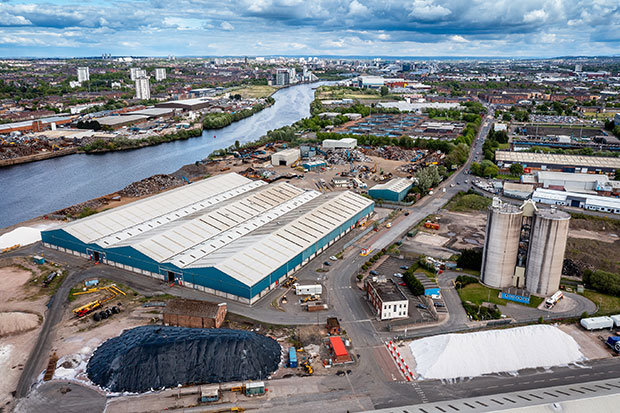
Considering both these shifts, new sources on bigger vessels and storage being asked to do more, the balance tips towards ports on the west coast. That’s the case for our King George V Dock in Glasgow and the Port of Liverpool facilities, with both offering the deep-water berths that take Panamax vessels of up to 65,000 tonnes. This allows importers to land larger cargoes in a single call, and both ports sit within reach of the UK’s main manufacturing and distribution networks by road, rail and coastal shipping.
Liverpool backs that up with around 900,000sq ft of covered, fully traceable warehousing to hold urea and other fertiliser products in condition through the spring peak, while King George V Dock is renewing its cranes, hoppers and loading shovels over the next six to 18 months.
King George V Dock also handles bonded warehousing, which lets importers defer duty and VAT until the products leave the store, providing a real lever on capital when holding thousands of tonnes across the year. The factors shaping where fertiliser is landed are changing. As supply sources move south and west, vessels get larger and importers place greater value on high-quality storage, the case for ports that combine deep-water access with substantial warehousing becomes stronger. For a growing share of the UK’s fertiliser imports, that creates a compelling case for looking west. For importers considering where to land urea and other fertiliser products, King George V Dock and the Port of Liverpool offer a combination of deep-water access, storage and inland connectivity that is worth considering.
Find out more about the facilities and options available at King George V Dock and the Port of Liverpool: www.peelports.com/alexandra-complex-warehousing
Comments are closed.