



Every warehouse eventually faces the same decision: invest in rugged, purpose-built scanning terminals, or equip pickers with ordinary smartphones. Get it wrong in either direction and it costs money – overspending on hardware nobody needed, or buying devices that can’t survive a single shift on the floor. The usual approach is to start with the device and work backwards from there. That’s the wrong order. Before choosing hardware, it’s worth understanding what actually determines picking accuracy and speed, and it isn’t the shell around the screen. That question matters just as much for a 3PL running multiple client contracts as it does for a single-site manufacturer or retailer.
 When a Rugged Terminal Makes Sense
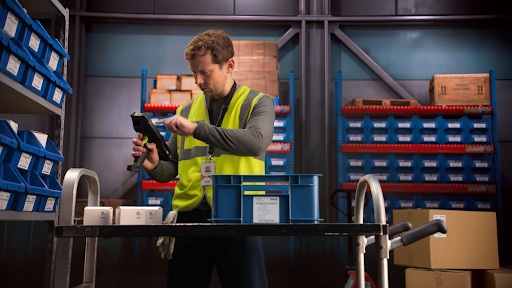
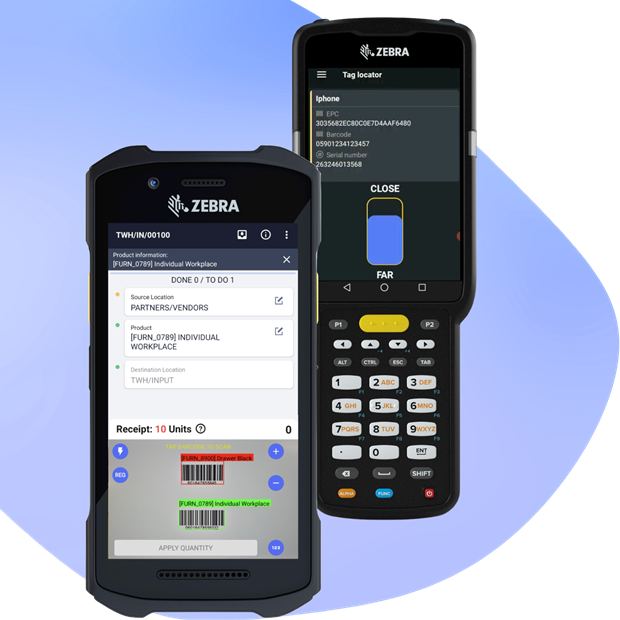
High-volume operations scanning hundreds or thousands of times a shift need hardware built for that load: multi-hour battery life, a drop rating that covers falls of a few feet onto concrete, and often a built-in laser or imager scanner rather than a camera doing the job. Cold storage adds another requirement – a device rated to work at sub-zero temperatures without the screen fogging or the battery draining fast. Pickers working in gloves need a screen and buttons that respond reliably without taking them off, and a device that survives being knocked against pallet racking several times a day without a cracked screen ending the shift early. This is the territory of devices like Zebra’s TC21/TC26, MC3300 or MC9300 – hardware designed from the ground up for continuous warehouse use, not office kit repurposed for the floor.
When a Smartphone Is Enough
Not every warehouse needs that. A smaller operation with lower scan volume, seasonal or temporary staff who don’t justify a device investment, or a limited hardware budget are all good reasons to start with ordinary smartphones instead. Smartphones also deploy faster: a new starter can be handed a phone and be scanning within minutes, rather than waiting on procurement and provisioning for a batch of rugged terminals. The requirements are modest: any Android device with at least 2GB of RAM (3GB or more is more comfortable), a screen of 4.5 inches or larger (5 inches is better for all-day use), and a working rear camera for barcode scanning. That’s it. A warehouse doesn’t need to commit to expensive terminals to get accurate, connected picking – it needs software that works properly on whatever Android device is already available.
The Real Decision Is Software, Not Hardware
A rugged terminal running the wrong application is still slow and error-prone. A smartphone running the right one can outperform it. Ventor PRO is a native Android application for Odoo Inventory, covering picking, receiving, stocktaking, and internal transfers directly from the device – unlike Odoo’s own Barcode app, which runs in the browser rather than natively on the device. It works the same way, with the same interface, on Zebra, Honeywell, Newland, and CipherLab terminals as it does on a standard smartphone, which means a warehouse can start on smartphones and move to rugged terminals later without changing the software or retraining anyone.
On the floor, it handles route optimisation for pickers and batch picking, grouping more than 450 orders into a single picking run where volume justifies it. Licensing is per device rather than per user, so two shifts can share one scanner without paying twice. Label printing runs through Direct Print PRO, and RFID is supported where the operation needs it. The device is replaceable. What’s running on it usually isn’t.
Numbers That Matter
Ventor PRO runs in more than 1,000 warehouses worldwide every day, supporting over 5,000 warehouse workers across manufacturing, retail, and third-party logistics operations. VentorTech has built on Odoo since 2014, and holds Gold Partner status with Odoo alongside official partner status with Zebra. One example from a long-time customer: Solter, a Spanish client, used Ventor PRO to count more than 4,000 products across over 1,600 locations in a single day – the kind of stocktake that would otherwise take a warehouse team most of a week.
What to Ask Before You Buy
A few honest questions before signing off on new hardware: How many scans does a picker actually do in a shift? Does any part of the operation run below freezing, or involve gloves? Is the current bottleneck really the hardware, or the software running on it? And would today’s decision still make sense if order volume doubled next year?
For many warehouses, the answer points to starting with the devices already on hand and the right software running on them. Ventor PRO offers a 14-day free trial for warehouses that want to test that before committing to new hardware.
About the author: Katya Baravikova is a Product Marketing Manager at VentorTech, an Odoo Gold Partner and official Zebra partner. She works on Ventor PRO, the mobile warehouse app for Odoo used in more than 1,000 warehouses.
Comments are closed.