



With recent advances in lead acid and lithium batteries, it is now increasingly important to partner batteries with the appropriate chargers.
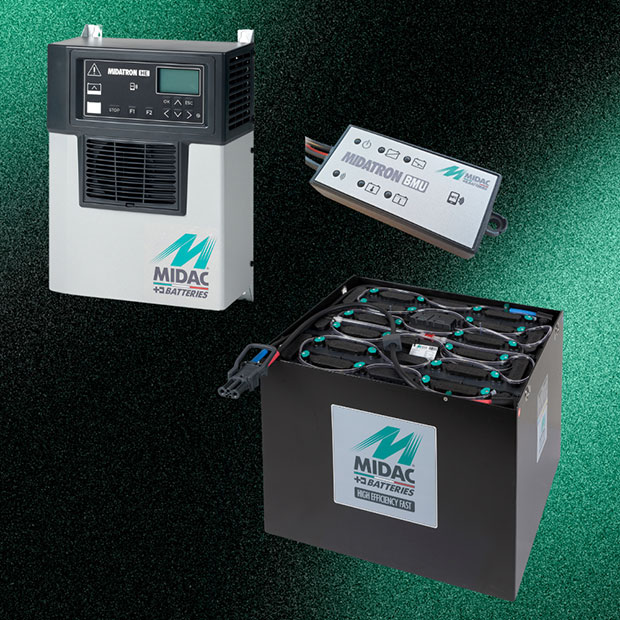
The move away from 50hz to high frequency charging has improved charger efficiency substantially, as smaller transformers and advanced electronics have become increasingly adept at converting the power from AC to DC, resulting in less electricity required to charge batteries and lower energy costs.
The latest Opportunity and Fast-charge battery systems are supplied as a package and batteries and chargers are programmed to work together to maximise efficiency and lower energy costs. Site shift patterns are identified, and chargers and batteries are sized to suit the customer applications. This technology has been assisted by the development of monitoring tools that assess battery condition and usage. Data collected by these tools is communicated to the charger, which enables the correct battery charge to be applied and facilitates opportunity and fast charging so that a battery can last to the end of a shift and in some cases up to 24 hours.
Additional benefits of the latest technologies include Dynamic Power Limitation (DPL) and Charging Time Restrictions. Increasingly, operations are experiencing restricted power supplies as the National Grid faces growing pressure. Midac High Efficiency chargers can now control battery charging times during peak periods and limit power draw when operating within a restricted power supply.
DPL ensures a defined group of chargers do not exceed a maximum power threshold and facilitates priority charging to batteries based on state of charge (SOC) levels. Charging is delivered through a smart algorithm and eliminates the risk of high-power peaks caused by simultaneous opportunity or fast charging that may exceed power supply capabilities. This prevents overload damage to the customers’ electrical infrastructure.
Charging Time Restrictions is a new feature which allows customers to control charging at set intervals throughout the day to suit customers’ operational requirements. This can limit battery charging during peak periods, thereby reducing charging costs. Chargers can be programmed to ‘hibernate’ at set times and charging is paused until the hibernation period is complete. Post-hibernation, chargers resume the battery charging cycle, reducing electricity bills and managing power supplies where required.
Gary Penfold, Sales Director of Midac UK & Ireland, comments “Midac’s latest battery and charger systems are revolutionising the industry. Energy costs are ever increasing, and some sites work with a restricted power supply, which all adds pressure to operations. At Midac, we have worked hard to reduce charging costs and give customers the tools to reduce waste and become more efficient.”
For more information contact salesuk@midacbatteries.com.
Comments are closed.