



Background
Nabuurs Supply Chain Solutions Oosterhout is a fast-moving logistics environment under growing operational pressure.
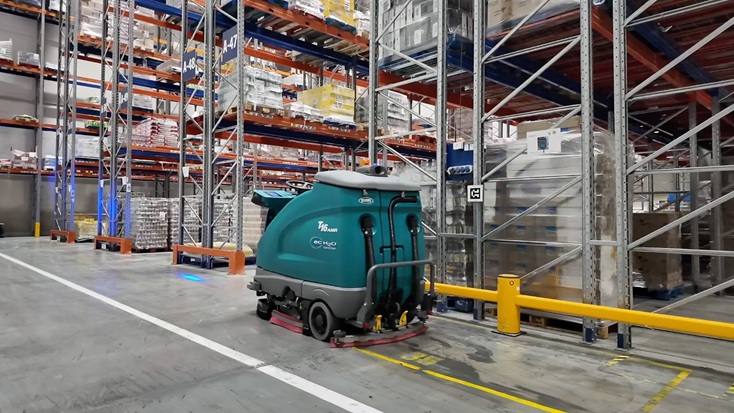 Keeping large logistics and warehouse environments consistently clean is increasingly challenging, particularly as businesses face rising labour costs, operational pressures, and demands for greater efficiency.
 At Nabuurs Supply Chain Solutions Oosterhout site in the Netherlands, maintaining cleaning standards across a 60.000m² logistics environment required significant daily floor cleaning. While the company was already using a Tennant M17 ride-on scrubber, the amount of manual labour required to operate the machine for long periods each day created growing cost pressures.
Rather than simply replacing existing equipment like-for-like, Nabuurs began exploring whether autonomous cleaning technology could deliver the same cleaning performance while significantly improving operational efficiency and reducing labour dependency.
Following a pilot programme and detailed ROI assessment carried out with Tennant, Nabuurs decided to transition from the conventional M17 scrubber to the Tennant T16AMR autonomous floor scrubber.
The challenge
Balancing cleaning performance with labour efficiency.
Before implementing autonomous cleaning, Nabuurs relied on a Tennant M17 scrubber dryer for warehouse floor cleaning. While the machine delivered strong cleaning results, operating it required a dedicated full-time employee for many hours every day.
As operational costs continued to rise, this model became increasingly difficult to justify from both a labour and efficiency perspective.
According to the team, the core challenge was not cleaning quality itself, but the amount of labour required to maintain it consistently across such a large logistics operation.
“Previously, we were cleaning the floors manually with a conventional machine. The results were good, but it required many hours of labour every day.’ Harrie Gijsbers / Dave Goedkeure, Nabuurs Supply Chain Solutions.
Following discussions with Tennant, the team explored whether autonomous cleaning could reduce labour pressure while maintaining or improving overall cleaning standards.
Choosing the right solution
A flexible autonomous cleaning model.
Following an operational review and pilot deployment, Nabuurs selected the Tennant T16AMR autonomous floor scrubber.
The machine was particularly well suited to the site because of its:
– Ability to clean large warehouse environments autonomously
– Cylindrical brush configuration suited to logistics floorcare
– Co-bot functionality, allowing both autonomous and manual operation
– Advanced navigation and safety functionality powered by BrainOS®
The pilot phase played an important role in building confidence internally. Tennant presented a detailed ROI model comparing the conventional M17 cleaning approach with the projected long-term operational savings of the T16AMR.
According to the project team, this immediately demonstrated the potential value of autonomous cleaning for the site.
Deployment
Preparing the organisation before full implementation
One of the most effective aspects of the deployment was the way the pilot programme was structured internally.
The decision to move forward followed a one-month pilot programme, during which the T16AMR was tested in live warehouse conditions. The pilot allowed both Tennant and Nabuurs to assess cleaning performance, route optimisation and potential labour savings before making a final investment decision.
Rather than treating the robot as a standalone technology project, Tennant advised Nabuurs to establish a dedicated internal cleaning team responsible for training and optimising the T16AMR during the pilot phase.
This allowed the team to:
– Train the robot across all cleaning routes before purchase approval
– Optimise cleaning paths and operational timings
– Familiarise employees with day-to-day operation
– Build internal ownership of the solution early in the process
By the time the pilot concluded and the purchasing decision was made, all cleaning routes had already been programmed and tested.
This meant the transition into live operation was fast and highly efficient.
“Because all routes had already been implemented during the pilot phase, the machine was effectively ready to go from day one after purchase.” Harrie Gijsbers / Dave Goedkeure, Nabuurs Supply Chain Solutions.
Safety and operational improvements
Supporting busy warehouse traffic environments.
The latest BrainOS software updates introduced additional operational and safety functionality that proved particularly valuable within the busy logistics environment.
The system now allows operators to introduce specific “points of interest” where the robot can:
– Briefly stop in busy traffic areas
– Sound a warning horn when approaching intersections or crossings
– Navigate more safely around high-traffic warehouse routes
These features helped improve confidence around operating autonomous equipment within an active logistics environment involving vehicle movement and warehouse traffic.
“One important aspect for us was safety within the warehouse environment. The latest BrainOS updates, including stopping at busy traffic points and warning sounds, have helped improve confidence around operating the robot in active warehouse areas.” Harrie Gijsbers / Dave Goedkeure, Nabuurs Supply Chain Solutions.
Results
Reducing costs while maintaining consistently clean floors.
The most significant operational improvement following deployment was cost reduction combined with consistently maintained floor cleanliness.
According to the project team, the autonomous model allowed Nabuurs to maintain cleaning quality while significantly reducing the labour burden associated with daily floorcare.
Since deployment on 1 July 2025, the T16AMR has become an established part of the site’s cleaning operation. Over its first 333 days of operation, the machine has delivered consistent autonomous cleaning performance across the 60.000m² warehouse environment.
The T16AMR also helped ensure more consistent cleaning outcomes without operational delays, damage, or interruptions.
Key outcomes included:
– Reduced labour dependency for daily floorcare
– Consistently clean warehouse floors
– Improved operational efficiency
– Autonomous cleaning without production disruption
– Long-term ROI improvement versus conventional cleaning
Usage data shows the T16AMR cleans an average of 1,774m² per day, equivalent to 12,420m² per week and more than 54,000m² per month.
The machine operates autonomously for an average of 5.57 hours per week and more than 24 hours per month, helping Nabuurs maintain cleaning standards without requiring a dedicated operator throughout the process. During the trial, we cleaned almost the entire building every week.
Overall, nearly 63% of the machine’s operating time is now completed autonomously, demonstrating how successfully cleaning activities have transitioned from manual to autonomous operation.
According to Tennant estimates, the deployment has reduced labour requirements for routine floor cleaning by approximately 60–70%, allowing employees to focus on other operational priorities rather than spending hours operating a scrubber dryer.
The customer team also responded positively to the machine in day-to-day operation.
“Our collaboration with Tennant has been very positive. Not only because of their excellent service and support, but also because they continuously helped optimise the cleaning process together with us” . Harrie Gijsbers / Dave Goedkeure, Nabuurs Supply Chain Solutions.
According to Tennant, usage data showed consistently high weekly operating hours, demonstrating strong internal adoption and operational value.
A long-term partnership approach
“Nabuurs and Tennant have worked together for approximately six years, with the relationship continuing to evolve as the company explores new operational efficiencies and innovations within logistics. The site operates according to strict safety and 5S standards, ensuring an organised, clean and efficient working environment.” Chris Van Hal, Account Manager, Tennant.
Looking ahead
As warehouse and logistics environments continue to face labour shortages and increasing pressure to improve operational efficiency, autonomous cleaning is expected to play an increasingly important role within large-scale facilities.
For Nabuurs Supply Chain Solutions, the T16AMR has demonstrated how robotics can move beyond pilot projects and become part of a practical, day-to-day operational cleaning model.
The success of the Oosterhout deployment has also prompted discussions around potential future rollouts at additional Nabuurs locations across the Netherlands, as the company continues to explore opportunities to improve efficiency and standardise cleaning operations across its logistics network.
Conclusion
By introducing the Tennant T16AMR autonomous floor scrubber at its Oosterhout logistics site, Nabuurs successfully transitioned from a fully manual cleaning model to a more efficient blended autonomous approach.
The result has been reduced labour pressure, improved operational efficiency, and consistently maintained cleaning standards across a busy 60.000m² logistics environment.
Rather than simply introducing a new machine, the project demonstrates how autonomous cleaning can become a scalable operational solution within modern warehouse and logistics facilities.
Comments are closed.