



Most fleet managers running distribution trailers have a handle on tyre wear, brake maintenance and tail-lift servicing. Lighting rarely gets the same attention. It is easy to understand why. A failed light is a small problem until it is not. Until a vehicle gets pulled over, an inspection is triggered and a trailer is grounded at the worst possible moment.
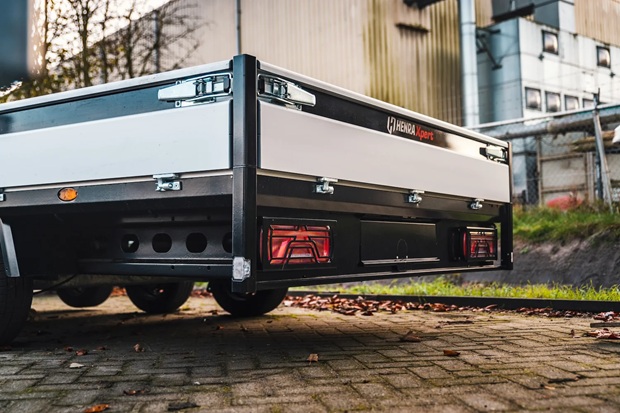 The lighting on a distribution or last-mile trailer is not complicated. But the way it fails tends to be.
Why trailer lighting fails more often than it should
The majority of trailer lighting failures we see in practice are not caused by faulty lights. They are caused by poor connections. Connectors that were never rated for outdoor use, or that were, but were fitted incorrectly. Wiring that was added to over the years as equipment changed, creating a loom that nobody fully understands anymore. Moisture working its way into a junction that was sealed well enough to pass an inspection three years ago but not well enough to survive two winters.
These are not dramatic failures. They are slow ones. The kind that show up intermittently, get temporarily fixed and come back six weeks later. For a workshop team managing dozens of trailers, that kind of fault is disproportionately time-consuming relative to how simple the underlying problem actually is.
The other issue is that trailer lighting problems tend to surface at the worst possible time: during a roadside check, at a customer’s yard, or at a port entry point. Not in the workshop where they can be dealt with efficiently.
What compliance actually requires
UK and European regulations set out clear requirements for trailer lighting under ECE R48, which covers the installation of lighting and light-signalling devices on vehicles. For trailers operating in distribution and last-mile logistics, the practical requirements include functioning rear lights, brake lights, indicators, marker lights where applicable and a correctly illuminated number plate.
None of this is technically demanding. What catches operators out is not ignorance of the rules but inconsistency in maintenance. A trailer that passed its last inspection may not pass the next one if a connector has corroded or a cable has chafed against the bodywork. The regulations do not change. The trailer does.
For operators running trailers across UK and European routes, compliance also needs to be consistent across jurisdictions. A vehicle checked in the Netherlands or Belgium is held to the same ECE standards, but enforcement practices vary. Having a lighting system that is verifiably correct, rather than approximately correct, reduces the risk considerably.
The case for a properly specified lighting system
There is a practical difference between a trailer whose lighting was assembled from whatever components were available at the time and one whose lighting was specified as a system from the outset.
A properly specified trailer lighting system uses components designed to work together. Connectors are rated for the environment. Cable runs are planned rather than improvised. Junctions are sealed to a standard that holds up over time rather than just at the point of installation. When something does fail, it fails in a way that is easy to identify and quick to fix because the system was designed with serviceability in mind.
For distribution fleets running 12V trailers on regular routes, this kind of specification is not a luxury. It is a maintenance decision that has a direct effect on vehicle availability. A trailer that comes back to the workshop for lighting faults twice a year costs more in downtime and technician time than one that does not.
TRALERT® supplies complete trailer lighting solutions for 12V applications including distribution trailers, agricultural vehicles and light commercial use, with components specified and tested to ECE standards. If your current maintenance records show recurring lighting faults, it is usually a sign that the underlying system needs attention rather than another temporary fix.
A maintenance issue worth taking seriously
Trailer lighting sits at the intersection of compliance, operational reliability and workshop efficiency. It rarely gets the attention it deserves until something goes wrong at a point where it causes real disruption.
The operators who handle it best tend to approach it the same way they approach any other maintenance-critical system: with a clear specification, standardised components and a servicing approach that addresses root causes rather than symptoms. That is not a complicated ask. But it does require treating trailer lighting as a system rather than a collection of individual parts that happen to be on the same vehicle.
Frequently asked questions
What are the main causes of trailer lighting failure in distribution fleets?
In our experience the most common causes are corroded or incorrectly fitted connectors, damaged cable runs from abrasion or moisture ingress, and wiring that has been modified incrementally over the trailer’s service life without a consistent standard being applied. These are all installation and maintenance issues rather than product failures, and they are preventable with a properly specified and regularly inspected lighting system.
What regulations apply to trailer lighting in the UK and Europe?
ECE R48 is the primary regulation governing the installation of lighting and light-signalling devices on vehicles including trailers. It sets requirements for the type, positioning, function and visibility of lights. For trailers operating across both UK and European markets the same ECE standards apply, making a certified lighting system the most straightforward way to maintain consistent compliance across jurisdictions.
For more information on trailer lighting solutions for distribution and light commercial applications, visit tralert.com/en
Comments are closed.