



Spend a few minutes inside a modern warehouse and you’ll notice something unusual. There’s a lot happening, but very little confusion. Boxes are moving, belts are running, machines are picking and placing items, and yet everything feels controlled. That kind of smooth operation doesn’t happen by accident. It’s built on layers of small decisions happening every second, and a big part of those decisions depends on proximity sensors.
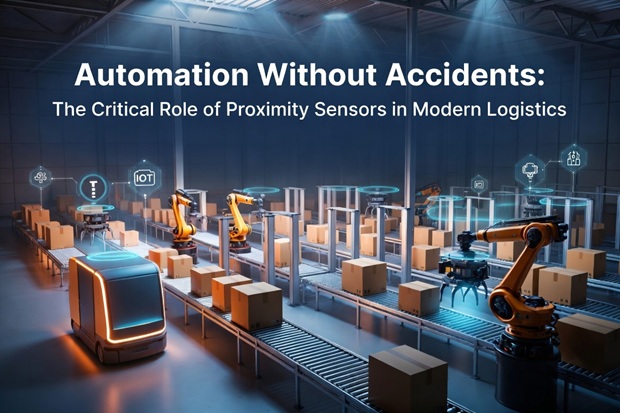 These sensors don’t get much attention. They’re small, relatively inexpensive, and usually hidden somewhere along a conveyor or inside a machine. But they are constantly answering a simple question: Is something there or not? And in logistics, that simple question can be the difference between efficiency and complete disruption.
Why “Not Touching” Is Actually a Big Deal
One thing that makes proximity sensors so useful is that they don’t need physical contact. That might not sound impressive at first, but in real working conditions, it matters a lot.
Imagine a conveyor line handling thousands of packages every hour. If detection relied on physical switches, those parts would wear out quickly. Dust would build up, parts would stick, and eventually things would stop working. Contactless sensing avoids all of that. No friction, less maintenance, and much longer life.
It also means faster response. The sensor doesn’t wait for something to press against it; it reacts the moment an object enters its detection range. In high-speed logistics systems, that kind of instant response is essential.
Different Sensors for Different Situations
Not every sensor works the same way, and that’s actually a good thing. Logistics environments are unpredictable; boxes vary in size, materials differ, and conditions are rarely perfect.
Inductive proximity sensors are widely used where metal detection is needed. You’ll often find them in machinery, checking whether a metal part is in the correct position. Capacitive sensors go a step further and can detect non-metal materials like plastic or even liquids, which makes them useful in packaging lines.
Then there are ultrasonic sensors, which are a bit more flexible. They don’t care about color or transparency, so they’re useful for detecting objects that optical sensors might miss. Photoelectric sensors, on the other hand, are great for longer distances and are commonly used in sorting systems where speed matters.
In real systems, it’s rarely just one type. Engineers mix and match depending on what needs to be detected and how reliable that detection needs to be.
What Actually Matters When Choosing a Sensor
Take sensing distance, for example. A few millimeters might be enough for precision machinery, but in a conveyor system, you may need a sensor that can detect objects from several centimeters or more. If the range is too short, detection becomes unreliable. Too long, and you risk false triggers.
Response time is another factor that people sometimes overlook. In a slow system, it might not matter much. But in logistics, where items move quickly, even a small delay can cause errors, missed detections, incorrect sorting, or system slowdowns.
Then there’s durability. Warehouses aren’t clean environments. There’s dust, vibration, sometimes moisture. That’s why many industrial sensors come with protection ratings like IP67. It’s not just a number, it’s what keeps the sensor working when conditions aren’t ideal.
And of course, output type matters too. Most systems rely on simple ON/OFF signals (like PNP or NPN), but in more advanced setups, analog outputs are used to provide more detailed information.
A Real Example: Conveyor Line That Thinks for Itself
Let’s make this more practical.
Picture a distribution center where packages are sorted automatically. As each box moves along the conveyor, it passes through multiple checkpoints. At each point, a proximity sensor is responsible for detecting its presence and position.
One sensor confirms that a package has arrived. Another checks spacing between items. A third ensures that the box is correctly aligned before it gets pushed onto another line.
Now connect all of that to an IoT system.
Instead of just reacting in real time, the system starts learning patterns. It can detect when packages are coming too close together or when something is slightly off in positioning. Over time, it can even predict when a problem is likely to happen like a jam forming in a specific section.
At that point, the system isn’t just automated, it’s becoming intelligent.
Safety Isn’t Optional in Automation
Efficiency is important, but safety is non-negotiable.
In a busy warehouse, machines don’t slow down unless something tells them to. Proximity sensors act as that “something.” They detect obstacles, confirm safe positions, and prevent machines from operating when they shouldn’t.
For example, an automated guided vehicle moving through a warehouse relies on sensors to detect obstacles in its path. If something unexpected appears, the system needs to react instantly. Without that, accidents would be unavoidable.
The same applies to robotic arms. Before picking or placing an item, they need confirmation that everything is in the right place. That confirmation often comes from a proximity sensor.
Where IoT Changes the Game
The real shift happens when these sensors are connected to a larger network.
In the past, a sensor would simply send a signal to a controller, and that was it. Now, the same data can be sent to cloud systems, stored, and analyzed over time.
This opens up new possibilities. You can track how often sensors are triggered, identify unusual patterns, and even detect early signs of failure. If a sensor starts responding slower than usual, it might be a sign that something is wrong.
Instead of waiting for a breakdown, maintenance can be planned in advance. That’s a big deal in logistics, where downtime can be expensive.
The Reality: It’s Not Always Perfect
Of course, real-world systems are never as clean as diagrams.
Sensors can get misaligned. Dust can interfere with detection. Electrical noise can cause false signals. And sometimes, the wrong type of sensor is used simply because it was cheaper or easier to install.
These issues don’t always show up immediately, which makes them harder to diagnose. A system might work fine for weeks and then suddenly start behaving unpredictably.
That’s why proper selection and installation matter just as much as the sensor itself.
Final Thoughts
It’s easy to focus on the bigger, more visible parts of automation robots, software, AI systems. But the reliability of those systems often comes down to small components doing their job consistently.
Proximity sensors are one of those components.
They don’t process complex data or run algorithms, but they provide the basic awareness that automation depends on. They tell machines what’s happening in the physical world, and they do it quickly and reliably.
In modern logistics, where speed and safety have to go hand in hand, that role becomes critical. Without accurate detection, automation doesn’t just slow down, it becomes unpredictable.
And that’s something no warehouse can afford.
Comments are closed.