



For many warehouses, the pack room is still treated as an operational afterthought. It is the place where boxes are stored, tape is applied and orders are closed out before despatch. Necessary, but rarely strategic. Yet as fulfilment models become more complex and customer expectations continue to rise, this way of thinking is no longer sustainable. The pack room is more than just a peripheral function. It is infrastructure, and increasingly, it determines whether a warehouse operates at speed or under strain.
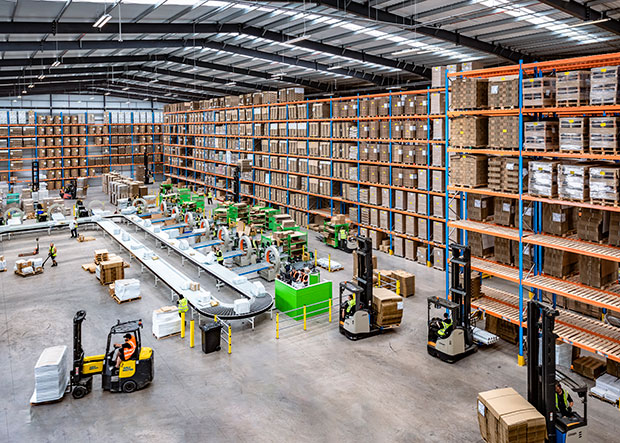
In high-throughput environments, packing is where upstream efficiency either converts into dispatched orders or quietly stalls. Delays caused by inconsistent box sizes, poorly laid-out workstations or excessive handling are rarely dramatic in isolation, but they compound quickly at scale. Over thousands of daily order lines, seconds lost per pack become hours of missed capacity. Damage rates rise, void fill increases, and labour is absorbed by rework rather than value-adding activity. When this happens, the pack room becomes a bottleneck. When it is designed properly, it becomes an accelerator.
The difference lies in whether packaging is treated as a consumable or as part of the warehouse system. Infrastructure thinking demands a different approach. Layouts are planned around flow, not convenience. Workstations are designed to minimise movement and decision-making. Packaging formats are selected for consistency and compatibility with conveyors, scanners and automation, not simply availability. The result is predictability, and predictability is what enables speed.
Standardisation plays a central role, but it must be applied intelligently. Reducing the number of pack types in circulation lowers complexity, shortens training time and supports automation. However, rigid uniformity rarely survives contact with modern SKU ranges. Warehouses handling mixed product profiles, fragile goods or regulated items still require flexibility. The most effective operations strike a balance: a small, disciplined set of standard pack formats for high-volume flows, supported by configurable and bespoke solutions that are clearly defined and tightly controlled. This approach preserves efficiency without forcing unsuitable packaging into the operation.
Packaging flow is directly linked to fulfilment speed, yet it is often one of the least measured elements of the warehouse. Metrics such as picks per hour and order cycle time are widely tracked, but the contribution of packing decisions to those figures is frequently overlooked. Touches per order, damage at despatch, void fill per parcel and packaging stock turnover provide a clearer picture of how well the pack room is performing. When these measures are monitored before and after changes to layouts or pack formats, the impact of packaging becomes visible and actionable.
Designing for today’s volumes is not enough. Warehouses must cope with growth and seasonal peaks without losing control of quality or cost. Pack rooms that only function well at average demand quickly unravel under pressure. Future-ready designs build in flexibility, allowing capacity to expand temporarily without re-engineering the entire process. Modular workstations, simplified peak pack formats and clear visual standards help temporary labour reach productivity faster. Crucially, these decisions should be made long before peak arrives, not in response to it.
Technology reinforces this need for foresight. Automation, whether partial or end-to-end, depends on consistency. Packaging that varies unpredictably in size, strength or presentation introduces friction that machines are ill-equipped to manage. Retrofitting automation around poorly considered packaging choices is costly and often avoidable. When packaging is specified with future systems in mind, integration becomes smoother and investment delivers faster returns.
None of this succeeds without the people who operate the pack room every day. Ergonomics, clarity and simplicity reduce fatigue and errors, while well-defined processes allow teams to maintain performance even during disruption. Warehouses that involve pack-room staff in improvement initiatives often uncover inefficiencies that data alone will not reveal. Small adjustments, suggested by those closest to the work, frequently produce meaningful gains.
At Kite Packaging, we see this shift first-hand. Increasingly, warehouses are asking not just what packaging they should buy, but how their pack rooms should function. Through on-site testing, performance measurement and engineering-led design, we help operators treat packaging as an operational asset rather than a line item. Our Mobile Packaging Laboratory allows real-world trials within live environments, ensuring that solutions perform under actual working conditions, not just in theory. This can be supported by a structured R&D audit that evaluates existing pack-room layouts, workflows and materials, then reconfigures them to optimise throughput, accuracy and scalability.
The pack room has always been central to warehouse operations. What has changed is the cost of getting it wrong. In an environment defined by speed, resilience and margin pressure, packaging can no longer sit in the background. Treated as infrastructure, the pack room becomes a source of competitive advantage. Treated as an afterthought, it quietly limits everything around it.
Comments are closed.