




Reactive robotics has delivered enormous efficiency gains for industry. But the technology is reaching its economic limits: systems that only respond to the current state scale speed – but not stability. As process complexity grows, small misjudgements lead to costly downtime. Stuttgart-based AI company Sereact is now introducing Cortex 2.0, a new generation of AI that evaluates the consequences of actions in advance and eliminates errors before they occur. The economic potential is immense.
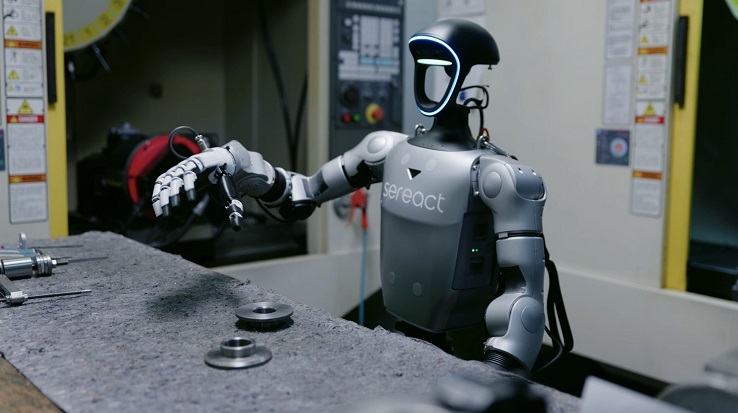 In logistics and manufacturing, the most expensive problems do not arise from a lack of precision or systems that are too slow, but from decisions whose consequences only become apparent with a delay. An unstable grip, an unfavourable sequence, or a minor deviation. What appears correct in the moment leads to bottlenecks, standstills, or damaged goods seconds or minutes later. The industry’s response to date has been clear: better sensors, faster reactions, more automation. This model scales speed above all else – not stability. As process complexity increases, so do risk and cost. Reactive systems are hitting a structural limit. This is precisely where Sereact steps in.
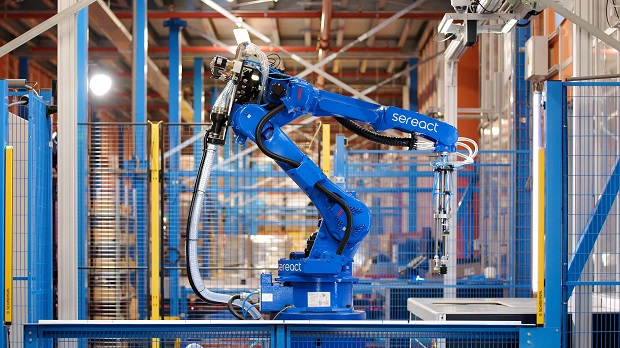 Predictive Physical AI
With Cortex 2.0, the Stuttgart-based AI company is pursuing an approach that advances physical AI not through faster execution, but through better decisions. Instead of allowing robots to react exclusively to the current state, Cortex 2.0 supplements control with a predictive assessment of possible courses of action. The system estimates which decisions could lead to problems later on and learns to avoid them.
Learning from real processes
The key difference to many current physical AI approaches lies in the database. Cortex 2.0 does not primarily learn from simulations, but from real-world operation. Sereact already operates several hundred robots in productive environments in Europe and the US . These deployments continuously generate data on how decisions affect real processes and how small deviations escalate or remain stable. “In industry, complex processes cannot be simulated realistically,” says CEO and co-founder Ralf Gulde. “Predictive action only arises where systems experience real consequences. Cortex learns precisely from these experiences.”
Why stability is becoming a key economic factor
This approach is economically relevant because unplanned downtime is one of the biggest cost drivers in automated processes. The higher the degree of automation, the more expensive wrong decisions become. Reactive physical AI reaches its limits here. It becomes faster, but not more robust.
Cortex 2.0 therefore clearly separates execution and evaluation for the first time. The robots remain fast and latency-free. The analysis of possible consequences runs in parallel and is fed back into the system via learning processes. This improves the quality of decisions without slowing down operations.
This capability will be crucial for the next generation of autonomous systems, such as collaborative robots, multi-stage processes, and, in the future, humanoid applications. Machines that work alongside humans or control complex processes must not only be able to act, but also assess what their actions will trigger.
Sereact is positioning Cortex 2.0 as the answer to a fundamental economic question of physical AI: How can automation and stability be scaled together? The solution lies less in even greater speed than in systems that understand the consequences of their decisions.
Comments are closed.