




It’s nothing new that space is at a premium in warehouses, and this lack of space is a huge roadblock for expanding businesses. But lately, there’s been a shift in how this is approached.
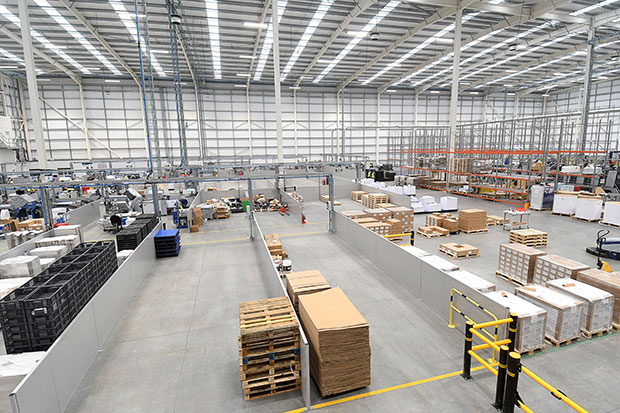
When there’s more stock and processes all crammed into the same warehouse footprint, but expanding isn’t an option due to skyrocketing costs – it makes sense that operators are turning to modular partitioning. And don’t be fooled by the name. Partitioning of this type are not your average walls by any means.
Modular partitions are moveable, adaptable, and surprisingly clever.
They let you play a magic game of Tetris in your warehouse that break up the warehouse floor to utilise it effectively. Whether it’s segmenting storage systems, creating zones for particular tasks or separating dusty work spaces from clean areas.
More Than Walls
At its simplest, a partition is just a wall… but in a warehouse, it becomes a more important part of the operation.
Depending on the material you choose, it can be adapted for a wide range of uses. Steel walls are tough and long-lasting and perfect for secure storage or heavy manufacturing areas. Workshop partitions often mix steel, mesh, and glass to create workstations that feel open (but still protected). Meanwhile, clean room partitions are in a league all of their own, as they are designed to reduce dust, germs, or other contaminants that could ruin any of your sensitive products.
Hygienic cladding is used where cleanliness is critical, such as food processing or pharmaceutical staging areas, with smooth finishes and flush joints that make cleaning easier to maintain crucial standards.
It’s worth adding that these are walls that can shift, so it’s not a big deal if your requirements change a few months down the road.
Partitions rarely exist in isolation.
Obviously, within the vast space of your warehouse, it’s highly unlikely that your partitioning will exist on its own, which is why you need your modular walls to blend seamlessly with your operations. The goal is to keep workflows clear, stock safe while maximising every inch of your space.
For example, mezzanine floors can be paired with steel partition walls and double hinged doors to develop a two-tiered unit. This setup maximises vertical volume while making sure divisions, operations or inventory categories are neatly separated.
Pallet racking can also be combined with steel partition walls to provide secure, high-density storage. Alternatively, shelf systems with mesh partitioning and security doors form secure cages for valuable or controlled goods.
How should I plan a warehouse partitioning installation?
Installing partitions is not as simple as putting panels up.
If you think partitioning could help boost your warehouse, you need to partner with a specialist who understands how to maximise the space while upholding the latest safety standards. This ensures every aspect of your warehouse partitioning system is designed around the way your space operates, and its modularity accounts for any future changes.
They should also understand how to navigate relevant fire ratings, acoustic performance, and building regulations.
Don’t move! Improve
The old phrase “don’t move, improve” has never felt more relevant. It’s 2026, and rising costs are showing no sign of slowing down. Plus, space is tight, and demand can be unpredictable.
Modular partitions let warehouses make the most of what they already have, creating safer and more productive environments without having to take extreme steps such as moving out.
If you take the right approach, these walls do more than just stand there. They become a huge part of how a warehouse functions, as demand grows and your operations evolve.
Comments are closed.