



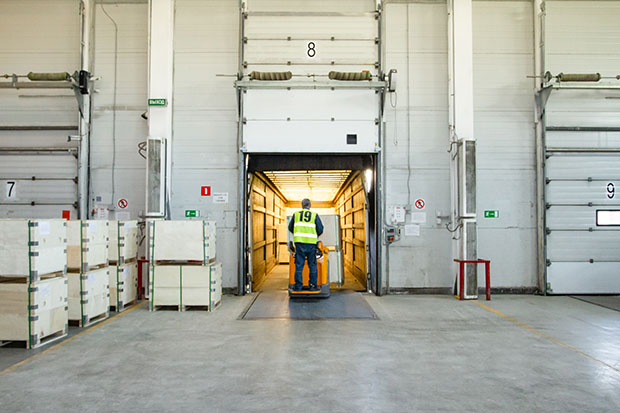
Loading bays are among the busiest and most critical spaces in modern logistics, and they remain central to operations. 24/7 facilities are managing anywhere between 300 to 1,500 deliveries every 24hrs. (Amazon Logistics Statistics (2026): Number of Package Deliveries) Loading Bays are the point where planning meets execution, where people and machinery operate in close proximity, and where the consequences of failure are greatest.
According to the UK’s Health and Safety Executive (HSE), the transport and storage sector records some of the highest rates of workplace injury, with 1 in 5 workplace fatalities caused by a forklift truck or industrial vehicle, and 25% of workplace fatalities caused by moving vehicles. (HSE Work-related fatal injuries in Great Britain, 2024: Workplace transport – HSE).
The surge in e-commerce and demand for rapid delivery has only intensified the pressure. Warehouses specialising in ecommerce can expect a daily throughput, goods in and out, of up to 1500 a day (Amazon Logistics Statistics (2026): Number of Package Deliveries) and are handling more vehicles and moving more freight than ever before. Loading bays are at the frontline of this activity, and under such conditions, the margin for error narrows, and the potential consequences widen.
Traditional methods, such as additional training or signage, only go so far in environments where split-second decisions are common and fatigue can build over long shifts.
Industry experts and safety professionals have long advocated for a shift from reactive safety measures to engineered solutions that contribute to addressing risk at its source. This principle is reinforced by the widely accepted Hierarchy of Controls, which places engineered controls above administrative approaches – such as training or signage – because they reduce reliance on human behaviour and therefore offer more reliable protection in high-risk environments. (Hierarchy of Controls | CDC, Occupational Health & Safety) Traditional methods like additional training or warning signs only go so far, as they depend heavily on human consistency, which is especially vulnerable in environments where split-second decisions are routine.
Engineered solutions, designed to minimise ambiguity and reduce reliance on manual judgement, are increasingly recognised as essential for achieving meaningful, sustained risk reduction and a valid solution to help operators balance the speed and volume (throughput) versus safety dilemma.
One approach gaining traction is the use of engineered interlocking systems that enforce safe sequences of actions. These systems ensure that tasks such as applying restraints, setting wheel restraints and operating bay doors occur in a controlled order, reducing reliance on manual judgement alone.
Salvo, the loading bay safety brand, part of the Sentric Safety Group, has been deploying this type of technology in warehouses for more than two decades. Its solutions are designed to minimise ambiguity and contribute to the prevention of the kinds of human errors that can lead to serious incidents.
“We work closely with operations teams to understand the challenges they face every day, including the speed and volume versus safety dilemma,” says Brent Dean, Global Product Manager for Salvo. “Safety systems need to reflect real working practices, not idealised ones. That’s why we focus on interlocked sequences that guide operators through the safest process every time.”
This industry-led design philosophy is central to how Salvo differentiates itself in a crowded market. Rather than retrofitting generic products, its systems are a tried-and-true solution for loading bays, and the specific hazards they present. As part of a wider safety group with global reach, the brand is backed by ongoing research and development and technical expertise that helps facilities integrate solutions in ways that work with, rather than against, operational flow.
Looking ahead, the company is preparing to launch two new safety products designed to meet challenges in loading bay operations. While details are still under wraps pre-launch, the developments follow extensive consultation with customers dealing with evolving fleet types, automation and regulatory scrutiny.
Fortunately, there is growing recognition that safety and productivity are not opposing forces. Employers who choose to prioritise protection for their people often see downstream benefits: fewer stoppages, reduced insurance claims and a more engaged workforce.
Whatever direction the sector takes, the loading bay will continue to serve as a critical point of control. It is where logistics meets reality, where people and machines work side by side, and where the stakes are highest.
By investing in robust, flexible safety systems and learning from real-world experience, warehousing leaders can make these high-risk spaces safer and more efficient, and in doing so can protect people, goods and reputations in equal measure.
Comments are closed.