



Established in 1999, Projected Image has quickly become the industry leader in high-quality gobos and durable full projection solutions.
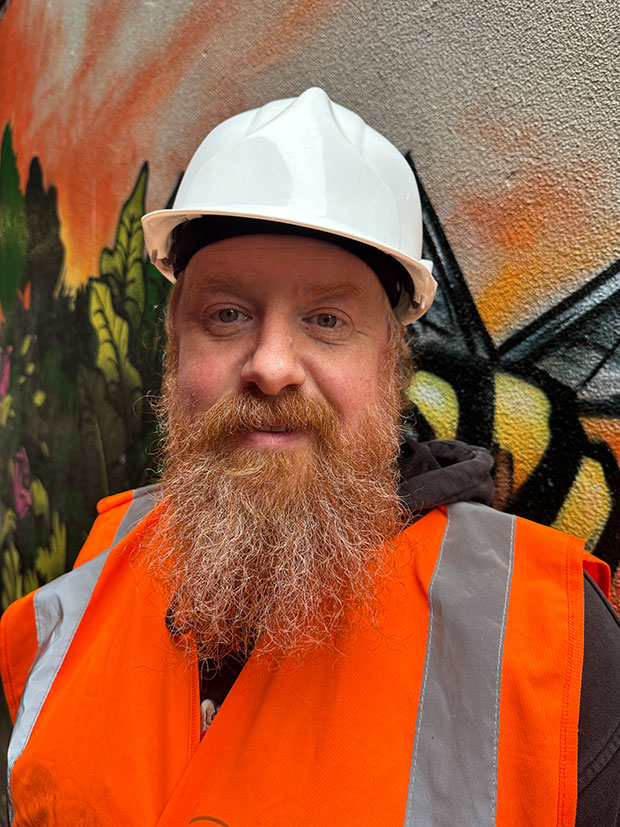
Managing Director at Projected Image UK
We not only manufacture our gobos in-house to the highest standards, but also provide full-service projection solutions for a wide range of applications and industries, such as warehouse safety signage, events and personalised signage.
Our wide range of virtual signage solutions and LED gobo projectors offer high visibility and durability, even in high traffic warehouses where painted floor markings degrade quickly. We have worked with many global customers, including Coca-Cola, BAE Systems and Mercedes Benz, developing durable and cost-effective signage solutions to improve safety on their sites.
From transforming event spaces with captivating visuals to enhancing warehouse safety through dynamic projected signage, we leverage our vast experience to deliver exceptional results every time.
Ian Spoors, Managing Director at Projected Image UK spoke to Warehouse & Logistics News.
What are your best-known products/solutions/services?
As experts in signage projection and lighting spaces, we offer a wide range of virtual signage solutions. We specialise in addressing challenges within industries such as manufacturing and logistics, providing turnkey solutions to the challenge of degrading floor markings, ineffective safety signage and more.
How do you think your industry sector is performing at the moment?
Health and safety is paramount to smooth, continuous operations across all sectors, especially warehouses, so budgets are going up. However, business confidence in the UK is the main challenge facing many sectors, with uncertainty due to less end-user demand and global trade pressures.
How many markets are you in and what is your biggest market?
The manufacturing market is a big customer for us, particularly in the UK automotive and food sectors. We also typically see a big uptake from the logistics industry.
What are your most recent product innovations?
With the warehouse 5.0 vision of using more robotics and automation in systems, we’ve found that our innovative automated projected signage is working extremely well in warehousing.
Can you tell us about any recent customer contract wins or projects and how you helped the customer meet their challenges?
We’ve recently worked closely with a large renewable energy manufacturer to automate a particularly difficult area within their facilities.
Their warehouse had a blind spot for pedestrians and heavy forklift traffic, which was posing a significant safety issue. PIR sensors were installed on a projected zebra crossing to pick up forklift traffic – and our automated projected safety signage solution instantly changed to ‘no entry’ for the pedestrians.
This increased visibility in their facilities and has already saved them money in repainting costs.
What is your strategy for growth and success in 2026?
We’re currently developing some additional safety products to introduce to the market, enabling us to offer a full warehouse safety solution.
Can you tell us about any areas, such as in AI, where you’re currently making technical advances?
We find lots of businesses are in very old facilities in need of modernisation – and our product has the technology to work with both older and modern environments.
New warehouse builders are installing our products alongside lighting and are programming them into large scale complex systems, such as projectors which are picked up by robots via IP locations and inbuilt sensors, coming alive to make a visual map for humans.
Also, our projectors are being retrofitted into old, even listed buildings and are simply wired into existing 240v circuits so businesses can move from outdated, worn paint to future proof virtual signage.
Plus, AI integration into motion sensors and signage is key for warehouse 5.0 builds to reduce accidents and pre-empt safety concerns.
Can you foresee autonomous mobile robots and goods-to-person systems becoming more mainstream to improve efficiency and reduce manual labour?
Definitely – and virtual signage can transform and adapt to these changes in warehouses, such as shutter doors being activated or layouts which move and are rerouted. Plus, robots are able to read our innovative safety signage quickly and easily.
Cameras or sensors can be mounted onto robots, enabling them to scan the environment and capture the safety signage projected in the warehouse.
Once the image is captured, the robot will utilise computer algorithms to detect and analyse specific shapes and patterns within the gobo signage projection. For example, the algorithms can be trained to recognise directions in arrows, text on safety signs, the colours of caution signage and more.
Using the information from the image, the robot can determine the instructions provided by the projected safety signs, such as following a specific direction or stopping before a loading bay or zebra crossing. We can see that this will have a big impact on efficiency.
Will advanced connectivity become more crucial for data sharing and communication between warehousing tasks and systems?
Having projected signage integrated into systems in the build stage of a warehouse can record footfall, traffic and incidents. This data can then be fed back to analyse and update.
One of the benefits of projected signage is that it can be changed and adapted much more easily than traditional painted or vinyl signage, which both typically require removal and business downtime.
Recording how many times there has been a close call via a camera near your signage can lead to more improvements and adjustments to improve workflow and efficiency.
Is the industry placing a greater emphasis on sustainability?
Warehousing and logistics, like all industries, are being driven to be more sustainable to meet government goals. Businesses have found that our product not only reduces carbon footprint in comparison to traditional paint and plastic signage, but increases a company’s electrification mandate by becoming more efficient using LEDs and light.
Are you placing greater emphasis on employee wellness such as investing in ergonomic environments and mental health support?
Our team are key to providing the service we promise, so just like health and safety signage, we take employee wellness very seriously.
In recent years, we’ve updated our manufacturing process to eliminate chemicals and all heavy machinery, in favour of top-of-the-line laser technology which is better for employee wellbeing.
Also, we offer mental health days and support from our Employee Assistance Programme which provides a free, unlimited-access helpline that can be used by staff and family members.
What sets your company apart from others?
Our company has been manufacturing and providing projected signage for over 26 years.
Not only do we have experience and knowledge that other safety signage companies don’t have, we provide a turnkey solution all under one roof too.
From the minute you pick up the phone and speak to a member of staff, you only deal with us – that’s everything from design communication, the site visit and survey, the product being manufactured and finally receiving your projection.
We are not relying on another business to supply or fix your problems; we only offer solutions.
How future-proof and flexible are your solutions?
Projected signage has been around for decades – but it’s only improving.
LEDs are becoming more powerful and affordable than ever, so these safety signs are visible, durable and adaptable.
Plus, as more automated warehouses are becoming staffed by machines, these signs are the more suitable safety solution in comparison to outdated paint and plastic.
How would you sum up your company in three words?
Innovative, Reliable, Experts.
PROJECTED IMAGE
0191 2659832
Comments are closed.