



As warehouse operations evolve at a rapid pace, traditional health and safety signage is struggling to keep up.
With the rise of automation, robotics and ever-changing layouts, printed and painted signs are proving too rigid for today’s fast-moving environments. Projected signage, however, is emerging as the more adaptable, cost-effective and future-ready solution.
“Warehouses face unique challenges. On top of heavy machinery use and footfall, there are new automated processes, robotics and increased demand,” explains Ian Spoors, Projected Image’s Managing Director. “Traditional safety signage is less effective at keeping up with these changes, whether that’s changes in layout or space usage, or the introduction of technologies like robots. Projected signage can be updated and relocated with minimal disruption, making it a versatile alternative that not only adapts to changes but enhances safety and efficiency too.”
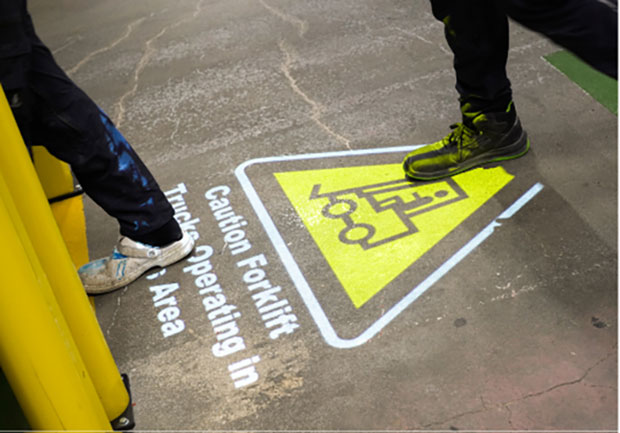
Unlike vinyl or painted floor markings, projected signage doesn’t fade, chip or wear away under constant traffic. Instead, it uses powerful LED gobo projectors and custom glass filters known as gobos to display vivid, high-visibility safety symbols and warnings onto floors or walls.
If layouts change or new hazards emerge, the projector can be repositioned and the gobo swapped for a new design. This flexibility eliminates costly repainting and reprinting while reducing business downtime – a major advantage in busy warehouses where efficiency is key.
Ready for robotics
Projected safety signage is also critical in the age of warehouse automation. Global warehouse robotics is forecast to reach $22.4 billion within the next decade, and as robots work more closely alongside people, clear and reliable safety communication is vital.
“Projected signage is easier for robots to read. It doesn’t change size, shape or colour, making it more visible to robots’ computer vision technology and algorithms. Robots can capture an image of the safety message, analyse it and then follow the instruction,” says Ian.
Where traditional safety signs can be obscured by equipment or become unreadable in poor conditions, projected signage offers consistency and visibility even in challenging environments. It can also be integrated with automation – for example, a warning sign projects only when a robot is approaching. With Warehouse 5.0 on the horizon, ensuring humans and machines work safely alongside each other is increasingly important.
A virtual step forward
To make adoption easier, Projected Image have launched a virtual warehouse model – an interactive tool that allows decision-makers to explore projected signage in a simulated environment. Users can move through a digital warehouse, view signage under different conditions and toggle between designs.
By providing a practical way to visualise solutions before installation, the model helps managers plan more effectively, streamline risk assessments and see how projected signage will work in their facilities.
“This platform showcases our dedication to continuous improvement, leveraging new ideas and technology to solve real-world challenges and empower clients to make decisions,” adds Ian.
Future-proof warehouse safety
Every warehouse is different, and Projected Image design and manufacture bespoke gobos to suit specific needs, from pedestrian crossings to forklift safety warnings.
This tailored approach is matched by long-term cost savings. Projected signage typically lasts up to 50,000 hours with minimal maintenance – a clear advantage over repainting or replacing traditional safety signs and floor markings.
For warehouses facing the challenges of automation, shifting workflows and high traffic, projected signage offers a safer, smarter and more adaptable alternative.
“Projected signage isn’t just a quick fix. We’ve seen that it’s a long-term solution that evolves with the space. As the industry continues to change, projected signage is essential to maintaining safety and efficiency,” Ian concludes.
More about Projected Image: projectedimage.com
Comments are closed.