




The warehouse has long been the backbone of the supply chain—essential yet often overlooked, writes Richard Stewart, EVP, Product and Industry Strategy at Infios. Once seen as static storage hubs, today’s warehouses are evolving into intelligent, dynamic ecosystems that move in sync with shifting demand, market conditions, and operational complexity.
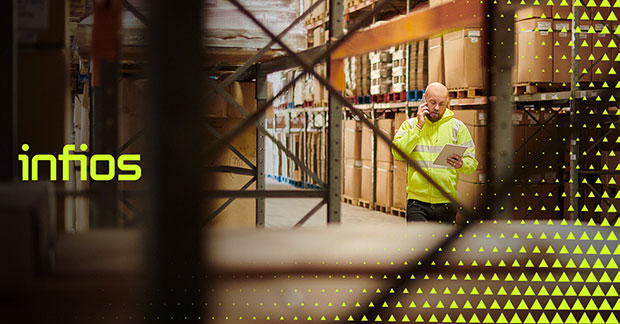
At the centre of this shift is artificial intelligence (AI). By embedding intelligence across warehouse operations, organisations are not simply improving efficiency—they’re redefining fulfilment itself. The warehouse is transforming from a reactive operation into a proactive, continuously learning system that drives performance across the entire supply chain.
From Static Storage to Strategic Execution
Traditionally, warehouses were designed for control: products were stored, moved, and shipped based on fixed rules and schedules. Even with early warehouse management systems (WMS) providing structure and visibility, decision-making remained largely manual.
AI is rewriting that playbook. By infusing intelligence into every process—from receiving and replenishment to picking and shipping—warehouses are becoming self-optimising environments. This is not automation for its own sake, but automation that empowers smarter decisions at every level, uniting human expertise with machine precision.
The Rise of Self-Aware Supply Chains
An AI-powered warehouse is defined by its ability to sense, learn, and adapt. This means moving beyond simple task execution to a state where systems make informed decisions in real time. We’re seeing that play out in several key ways:
• Live inventory awareness: AI combined with IoT sensors, RFID, and computer vision allows facilities to maintain pinpoint accuracy of inventory location and condition. Cycle counting is minimised, and inventory distortion is drastically reduced.
• Autonomous task execution: Robots and conveyors no longer follow rigid scripts. With machine learning and real-time coordination, they dynamically respond to changes in the environment—such as congestion, new priorities, or urgent orders.
• System-driven optimisation: Slotting, layout configuration, and resource allocation can all be continuously fine-tuned using AI models, not just reviewed quarterly or annually.
These capabilities don’t just improve efficiency—they unlock a level of agility that’s essential in a world of same-day delivery expectations and supply chain unpredictability.
Predictive Inventory: Planning Beyond the Now
One of AI’s greatest strengths lies in forecasting and pattern recognition. In the warehouse, this means using historical and real-time data to anticipate what’s coming next—and acting before issues arise. Take demand planning. AI can analyse not just sales history, but also inputs like weather forecasts, marketing activity, social media trends, and global events. This allows for smarter stocking strategies and fewer surprises during peak seasons.
And when it comes to inventory control, AI can:
• Flag emerging patterns that may indicate stockouts or overages before they happen.
• Trigger replenishment automatically based on real-time sales velocity, supplier performance, and cost thresholds.
• Recommend dynamic safety stock levels by product, customer, or channel—adapting as volatility increases.
In short, inventory becomes a living asset: monitored, predicted, and optimised in real time.
Fulfilment That Follows the Customer
Traditional fulfilment logic often centred on operational convenience—batch processing, standard shipping zones, linear workflows. But customer expectations have redefined the playing field. Speed, personalisation, and reliability now dominate the metrics of success.]
AI is the engine behind this new fulfilment paradigm. Intelligent orchestration allows systems to:
• Route orders to the best fulfilment location based on inventory position, proximity to the customer, and available labour.
• Select optimal packing configurations that reduce dimensional weight and cut packaging waste.
• Sequence orders in a way that aligns with carrier schedules, pick-line congestion, and customer delivery promises.
The result is an ecosystem that aligns more closely with customer expectations—without sacrificing operational efficiency.
Human + Machine: A Smarter Workforce
Perhaps the most misunderstood aspect of AI in warehousing is its impact on the workforce. While automation has historically been seen as a replacement for manual labour, AI enables something more powerful: augmentation.
Rather than removing people from the process, AI empowers them to operate at a higher level. It eliminates guesswork, surfaces insights, and reduces tedious manual decisions. Key examples include:
• Labour optimisation engines that dynamically adjust shift planning, task assignment, and break schedules to balance workloads and reduce burnout.
• Wearables and voice-enabled devices that guide associates through pick paths optimised by real-time traffic and priority logic.
• Cobots (collaborative robots) that assist with heavy or repetitive tasks, allowing workers to focus on quality control, training, or exception handling.
In environments where talent is scarce and turnover is costly, AI helps retain and empower the most valuable asset of all: the human workforce.
Smart Warehousing, Sustainable Outcomes
Efficiency and sustainability are no longer competing priorities—they’re becoming synonymous. Fortunately, AI supports both.
• Energy usage is optimised by linking HVAC and lighting systems to real-time occupancy data, reducing overhead without sacrificing comfort or safety.
• Packaging algorithms calculate optimal box sizes and packing arrangements, cutting down on filler material and reducing shipping volume.
• Order consolidation logic groups shipments with similar routes, trimming unnecessary mileage and lowering carbon emissions.
In an era where ESG commitments are under scrutiny, the AI-powered warehouse offers tangible ways to move the needle—without compromising performance.
Resilience by Design
If recent years have taught supply chain leaders anything, it’s that volatility is the new normal. From global trade disruptions to labour shortages and demand surges, the ability to adapt quickly is now more important than optimisation alone.
AI delivers resilience. When exceptions occur—whether it’s a supplier delay, a staffing shortage, or a surge in orders—AI-enabled systems can respond immediately. They can reroute orders, reallocate tasks, and re-prioritise resources without waiting for human intervention.
In this way, the intelligent warehouse doesn’t just operate efficiently during ideal conditions—it thrives under pressure.
A Platform for What’s Next
Warehouses are no longer endpoints in the supply chain—they’re engines of execution. And with AI as the foundation, these facilities become adaptable, resilient, and insight-driven hubs that power the entire business. But AI isn’t a magic overlay. It must be embedded at the core of the execution platform—connected to real-time data, orchestrating people and machines, and designed to evolve as the business grows.
Organisations that invest in this level of intelligence today will be the ones positioned to lead tomorrow. Because fulfilment isn’t just about getting products out the door—it’s about meeting customers where they are, every time.
Final Thoughts: Intelligence Is the Differentiator
In the race to reimagine fulfilment, speed alone won’t determine who wins. The companies that pull ahead will be those that use intelligence to orchestrate complexity, drive smarter decisions, and create value from every warehouse action.
AI isn’t the future of warehousing—it’s the present. And for businesses ready to embrace it, the rewards are clear: greater accuracy, faster throughput, empowered teams, and supply chains that never fall behind.
Comments are closed.