




KNAPP’s AutoPocket sorter system solves two logistics challenges for retailer, Next – order fulfilment and outbound sortation.
Leading fashion and homeware retailer, Next plc has been reaping the benefits of its new distribution centre in South Elmsall, near Wakefield, since 2022. Connected to existing facilities by a link bridge, the new DC features automated systems from KNAPP that help the retailer to deliver customer orders the next day.
Every second counts
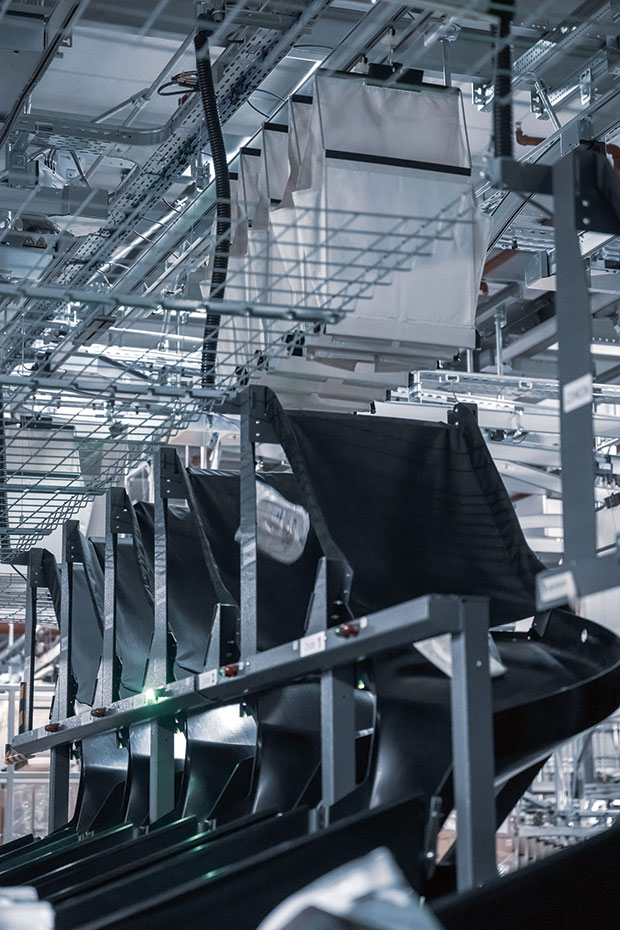
Looking to replace its legacy split tray sorter in order to increase throughput and reduce order-processing times, Next selected AutoPocket, the latest generation of KNAPP’s pocket sorter technology. With Next promising next-day delivery for orders placed by 11pm, rapid order processing is critical at the South Elmsall DC. AutoPocket arranges suspended pockets of goods into the precise sequence required for dispatch, with the added benefit of being able to deposit items precisely and fully automatically anywhere in the warehouse. The ability to release items without needing to stop – or even slow down – makes the AutoPocket system incredibly fast and efficient.
Two challenges, one solution
In the new DC, the KNAPP team solved two challenges with one solution. While two AutoPocket modules consolidate and sort e-commerce orders highly efficiently, a third module handles sortation in the goods-out area. Combined with intelligent software, AutoPocket optimises the flow of goods for Next from picking all the way to shipping.
The two order-processing modules handle 15,000 items per hour, while the outbound module sorts 5,000 parcels per hour. In total, the AutoPocket system at Next features 32,300 pockets and processes around 240,000 items a day. The savings for Next, compared to a traditional cross-belt sorter, amount to 35% in weekly personnel hours. In addition to reducing order-processing times, using a single technology secures benefits in terms of ease of maintenance and spare parts availability.
Automated tote store
KNAPP also supplied an automated shuttle store as part of its solution for Next. Containers from the store are automatically conveyed to one of 20 pocket-loading stations – 10 for each of the two order-processing AutoPocket modules – where up to 1000 items per hour are taken from the totes, scanned and loaded into an automatically supplied pocket. From here, pockets are forwarded to the module distributor, which allocates them to one of the AutoPocket modules, balancing the workload between them to maximise throughput.
Buffer pocket storage
The AutoPocket system transports pockets with single-item orders directly to the packing stations, while those with goods from multi-line orders are sequenced by the system’s matrix sortation algorithm. In the order consolidation area, each of the two AutoPocket modules has 14 buffers across two levels, where pockets of individual items are stored temporarily until all parts of an order have been processed and consolidated. Completed orders are automatically diverted from the rotating buffer to the six packing loops by the warehouse control system. Here, the pockets release their contents automatically at one of 240 chutes, which slide them to 60 packing stations. Employees pack all the items in an order into a polybag and these parcels are then fed onto a conveyor that transports them to the outbound sortation system.
Outbound sorter
Packed customer orders are inducted into the third AutoPocket module at one of six loading stations. The parcels are then sorted and distributed across 40 courier-specific drop-off points via the outbound sortation loop, from where they are shipped to customers worldwide.
Versatile and scalable
The AutoPocket is an incredibly versatile technology. As well as the order-fulfilment and outbound sortation tasks performed at the Next DC, AutoPocket can act as a highly efficient solution for processing returns. In addition, its modular construction means that the system can be scaled flexibly by adding sorter modules as volumes grow.
Comments are closed.