


As experts in permanent perimeter protection, Heras offers support for the most complex logistics operations in Europe. These include DPD and DHL’s increasingly busy transport and delivery services across the UK and Europe, cargo transport at Schiphol Amsterdam Airport, to the medical distribution centres of Rhenus Logistics.
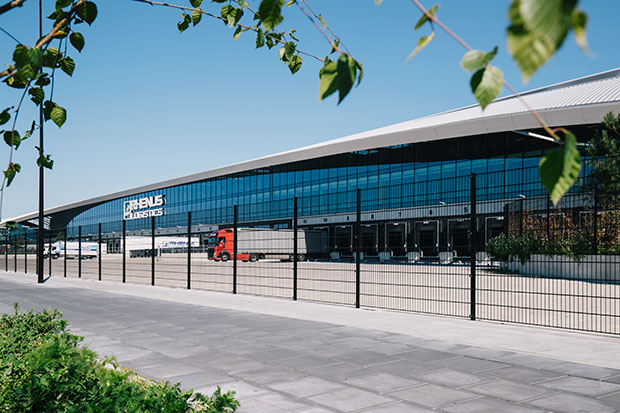 These locations feature designs and layouts complying with the latest operational guidelines and are equipped with advanced technology. Many organisations consult with us for advice on the design of their security solutions.
Two important factors that are common for logistics companies to consider:
1. Every outside area has its own nuance and complexity. Much of the difficulty depends on the available space around the building – or a lack thereof – and the type of goods handled on site. The space on a site mainly influences logistical movements.
2. The type of goods on site largely determines how much risk a company must anticipate for theft or burglary.
A well-designed and well-secured site therefore not only keeps unwanted and unauthorised people out, it also ensures that all traffic on the outside moves to where it needs to get to as quickly and efficiently as possible. All this is achieved in a way that does not compromise the safety of all people on the site. Moreover, you will avoid unexpected surprises, which are costly and time consuming to deal with.
To take detailed next steps, a clear picture of all your daily procedures are needed and then all and any scenarios which could or would impede these daily procedures need to be clarified, as these are what you are looking to prevent. To determine those scenarios, there are five fundamental questions that you must ask yourself.
1. The goods – what is the value and where is the storage?
What is the value of your goods? How easy are they to transport? Are your goods mostly inside or outside? These are the most important security questions that apply to every company in logistics services when assessing risk. The answers largely determine which measures you must take. If valuable goods are outside – for example, raw materials or containers – and are easy to carry, your security must be of a high level. This way you prevent criminals from entering your premises, or at least not being able to leave your premises with your goods. Are your valuables inside? Even then, good security of your site is important to slow down possible intruders and increases your response time to incidents.
2. Opening hours – Is the operation 24/7 or closed in the evening?
This question seems simple, but it has a considerable impact on the design of your security. If staff occupy your premises day and night, the need to deter criminality outside of peak hours is not as prevalent. Not that you can sit back, but the level of security is lower than a building that is closed at night. For this you need to take more measures to prevent theft or burglary. Think of a more robust fence, protection against breaking your demarcation line and detection with cameras and sensors.
3. Traffic – What traffic flows are on site?
Logistics is, by definition, a complex process that involves many different stakeholders. This is clear when assessing external security. You have to deal with staff, visitors, suppliers and other parties. That is why it is wise to create a detailed inventory of the traffic flow that must be dealt with at any time of operation. How do you ensure that freight traffic enters the site as quickly as possible? Where does your staff enter the site? Where can visitors park their car? How do you ensure that emergency services get access to your site as quickly as possible? All of these are relevant questions that require answers before you can organise the different traffic flows on your site.
4. How many logistics movements are taking place on my site?
It is important to gain insight into the amount of logistics movements on your site. This way you ensure that you can process these movements as efficiently and safely as possible. Both when granting access and routing on site. If dozens of trucks and vans drive onto your site per hour, you probably need several access points. That way you can grant multiple vehicles access simultaneously and quickly. It may even pay to automate access control (in part) with license plate recognition.
5. Regulations – Which laws do you have to comply with?
Consider carefully what current laws and regulations you are dealing with. That way you know for sure that you meet all of the requirements. Don’t just look at the government, as there are also other parties that draw up rules and guidelines. Consider the sector organisations such as the Transport Asset Protection Association (TAPA) or your insurer. These parties usually provide useful tips on the design and security of your outside area.
Take advantage of the knowledge of others
As you can see, there are a number of factors that are important for the design and security of your outside area. Answering these questions, considering all factors and interpreting needs correctly is a significant task. Established in 1952, Heras has successfully met and exceeded customer’s safety and security needs across Europe over many years. Companies in your industry run into the same questions and we have already answered them. Recently, Rhenus Logistics shared how they arranged the security of their outside area together with Heras.
Heras
Comments are closed.