




In the last year the logistics industry has taken on change at a volume and pace never anticipated. Our customer has reacted to the Covid Pandemic by using Online Shopping to create distance AND, GUESS WHAT? – WE DELIVERED.
 So now we strive to plan how we progress from where we are to meet the challenges ahead. If we were to use lonely hearts terminology, we might describe ourselves as “worried of warehouse, in need of a partner with experience of digitisation, understanding other people’s needs and cybercrime!” All this in addition to meeting our customer’s expectations of speedy delivery.
How do we meet the costs of future requirements? Let’s think for a moment about reducing current operating costs. In a recent HSE webinar one of the messages that stood out for me is actively managing risk assessment. Apparently, many times inspectors are greeted with diligently created files and little to show that the assessments they contained were actively managed. The point was made that we know that a risk exists, and yet do nothing to prevent the incident waiting in the workplace. One such issue is that of damaged stock. In an article by Harvard Review describing the cost of Holding Inventory, destroyed inventory represented 3% of the total of $500,000 held. Damaged stock a further 5-7% depending on industry. This example comes from the Paper Industry. So, this seems to be a cost that we may benefit from reducing. What is it that makes many otherwise successful leaders in our sector seem to ignore the inherent costs of damaged stock? If we can save money here, it could then be used to achieve our plans. OK, maybe it is viewed as inevitable and after all, it’s tax deductible. So why do we need to do anything?
We already have recoup to address some of it. Stock damaged or destroyed offset against tax is valued at the amount that the company could reasonably sell it for in the current market. How much does it cost in time to calculate this? Tempting to use a rule of thumb and deduct a given percentage each year. Being tax deductible is a strong motive to do nothing. Until you get to the other costs generated by damaged stock.
If you break one item of stock you have to sell five more to replace the cost and potential profit that would have been made by a sale. There is an additional cost of this replacement production. Not just the item itself fuel, harmful emissions, wages and failing to meet the customer’s need all contribute. Some can be counted in hard cash, some in service and reputation. I wonder how HMRC would view a claim for harming the planet against Corporation Tax?
Another consequence of damage to inventory is that of its impact on Health and Safety. Protecting vulnerable stock while on the pallet and during order fulfilment removes debris from the warehouse floor and so there is less to cause Slip, Trip and Fall accidents. Transport and Storage is still above the all industries rate of these accidents at 1790 per 100,000 workers. Slips and Trips are still the most common injury at 29% of total accidents across the UK.
With the Logistics industry employing 2.5 million people in the UK and 76% of non-fatal accidents taking up to 7 days off, 24% over 7 days off, we can get to the cost at minimum wage for just one aspect of the cost to employers, that of wages.
So, up to 7 days, using 3.5 days gives a wage only cost of £8.485m. Over 7 days, using 8 days to calculate equates to £5.970m. A total of £14.455m.
A new solution to a perennial problem
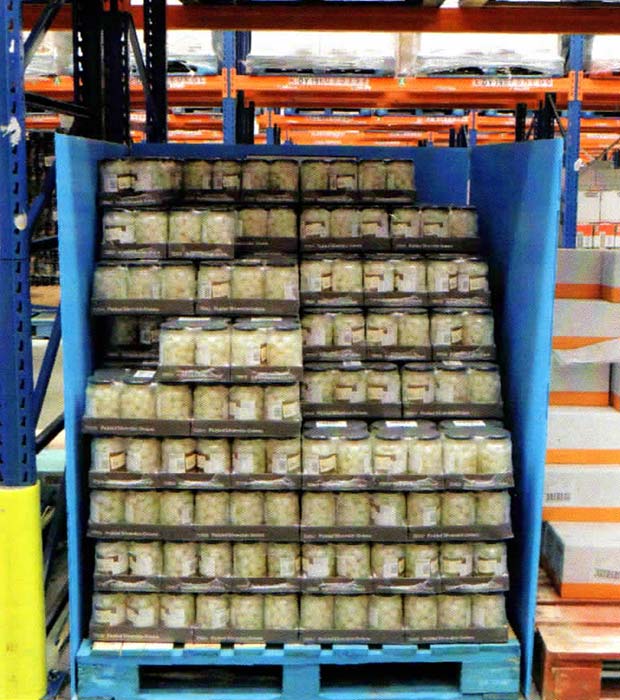
The way to decrease the cost of damage and accidents is to use stock protection for vulnerable (very breakable or very costly) stock. Our unique Stock Protector surrounds the pallet on three of four sides preventing stock migration and damage. Deceptively simple to look at in its design, the Stock Protector stays in the racking. It adjusts to receive the next pallet. It’s guaranteed against all but harm by fork lift truck for five years. The most you will ever pay for a Stock Protector is £200.00 plus VAT. So, you have protection long after your investment is returned.
Another way to make the attainment of these savings more accessible is given to us by the Chancellor of the Exchequer. The Annual Investment Allowance has been increased to £1m to stimulate business investment. In previous years it has been between £2 and £5 hundred thousand pounds. If you would like to explore further go to HM Treasury, Budget 2021 – Super-Deduction.
If you want to see more about our Stock Protector, go to www.abbos.co.uk. Or feel free to call me to discuss the points raised here.
ABBOS Ltd
Carolyn Svahn
t: 07543 989387
Comments are closed.