




With just one month to go it appears British exporters are getting ready in earnest for Brexit, with a leading south east pallet producer doubling its sales of Heat Treated Timber Pallets (HTTP).
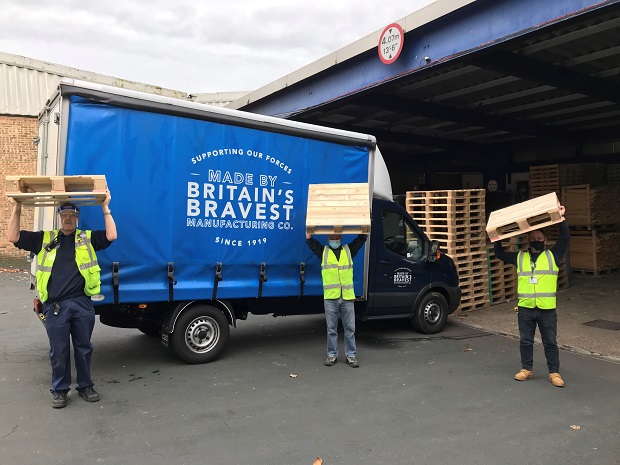 Britain’s Bravest Manufacturing Company (BBMC), based at Aylesford in Kent, has reported that HTTP sales have risen from 6,000 to 12,000 a month since October.
HTTP now accounts for 40 per cent of all pallets made by the company, which is the social enterprise arm of Royal British Legion Industries.
Kate Bull, Managing Director of BBMC, said: “In the absence of the final detail of the trade deal between the UK and EU, exporting businesses have recognised they need to plan for all eventualities.”
However, Kate Bull added: “It is still possible that from 1 January, the UK will have Third Country status. This would mean all pallets entering the EU would need to be heat treated in order to comply with International Standard for Phytosanitary measures no.15 (ISPM15), adopted by the EU.
“While we must hope that a pragmatic approach to the use of non-heat treated pallets is adopted, we must be practical and realistic about the risks. In theory, inspection regimes could be introduced at UK-EU borders. At best this could slow the movement of goods, and in the worst-case scenario could result in entry being refused, which would be hugely damaging for British firms and their relations with their European customers.”
BBMC is accredited by Timcom as an ISPM (heat-treated) manufacturer, guaranteeing all its pallets and packing materials meet the required international standards.
A number of BBMC’s clients, including Zotefoams, Saracens, Hoganas and WE Roberts have already been making a switch to HTTP in response to the possible changes. The team is also working with many others to put plans in place to increase their stock of the EU-approved pallets.
The social enterprise employs 110 people of whom 70% are military veterans or disabled, with all profits made by the company reinvested in its growth or RBLI’s training, care and accommodation for former military personnel.
Ninety per cent of pallets used by the logistics and distribution industry are manufactured from wood and are fundamental to the supply chains of key sectors, supporting the delivery of food, medicines and other essential goods to retailers.
The Timber Packaging & Pallet Confederation (Timcon) believes there remains no scientific or fact-based rationale to justify any change in enforcement applied – because there will be no difference to the negligible plant health risk posed by these movements after Brexit.
For further information on how BBMC can help south east exporters be prepared from 1 January please contact: Martin.Easterby@rbli.co.uk or Justin.Wilkes@rbli.co.uk
Comments are closed.