




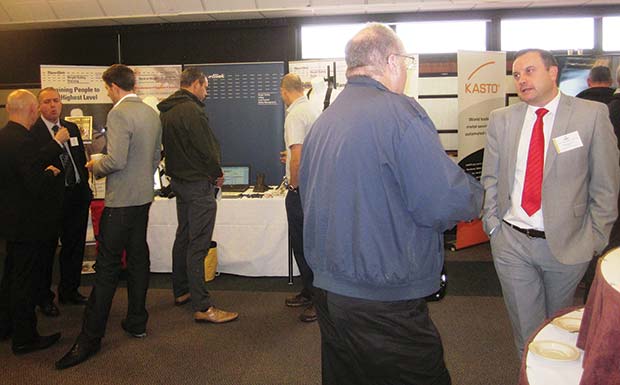
Twelve speakers illustrated a raft of measures with case study examples to illustrate best practice at SEMA’s November Annual Safety Conference, Safety in the Storage Industry: Working towards Zero Harm on 6th November.
HSE statistics still cite falls from height in the food and drink industries as the third highest cause of fatal injury, (20% of fatalities and around 80 major injuries each year). Neil Pinder of safety specialist, Spanset spelled out to a 100 or so delegates that in his experience, risk assessments are not undertaken frequently enough, that training only usually has a three-year lifespan and safety procedures should follow the KISS Principle (Keep It Simple S……!) He advocated; “Plan your work and work your plan”.
SEMA’s technical committee (STC) chairman Steve Cowen spoke out on another area of real concern; that of a method of rack repairs that straightens damaged uprights using a jig and a hydraulic ram without offloading pallets before undertaking the repair. SEMA’s technical committee believes that this method of repairing adjustable pallet racking could be extremely dangerous and flies in the face of health and safety best practice enshrined in the HSE’s guideline on Warehousing and Storage, HSG 76.
SEMA’s view is that pallet racking should always be offloaded before repair, there is no much-needed ‘peer-reviewed’ public research available on these techniques and any end user or supplier undertaking this practice is seriously exposed should an accident occur.
SEMA Approved Rack Inspectors (or SARIs) Mike Pace and Stuart Howard highlighted the dangers of racking collapse should adjustable pallet racking be altered to exceed weight loadings. The point to note is that each displayed load notice is uniquely traceable to a specific job number which is given a date and location reference. The need for rack upright protection was also highlighted.
SARIs implement a traffic light system in respect of rack inspections and maintenance. Green requires surveillance where defined damage limits are not exceeded as per the SEMA Code of Practice. Amber damage requires ‘Action a.s.a.p.’ or normally within a four-week period. A Red risk indicates serious damage where repairs with identical new parts are required, in line with SEMA’s Code of Practice. The bottom line is that users must always demonstrate a safe system of work is in place.
HSE Inspector Jenny Skeldon explained how best to comply with the statutory body’s ‘Fee for Intervention’ scheme and how it works. To best equip the industry, lawyer, Kevin Bridges of Pinsent Masons LLP gave sound advice on interacting with the Regulator and how best to guard against enforcement action while staying on the right side of the law.
Laura Nelson and Nick Welch of the RTITB provided useful guidance on choosing the right forklift for the application and expectations that should be placed on the employee in minimising forklift damage to adjustable pallet racking.
Arco’s Adam Willcock covered the standard applicable to eye protection with some practical examples and Brent Hudson of Machinery Safety & Compliance services discussed the safe use of storage systems in relation to PUWER and CE marking.
Martin Needham, MD of Lutterworth Ecolighting illustrated how by using new LED technology and lighting controls, not only will storage areas will be better lit, but LED will generate energy savings which offer payback on investment sooner rather than later.
Stadco Automotive’s Simon Randall spoke about the challenges and successes faced by this international Tier-One supplier of automotive products and services in order to enhance its safety management system across the board.
 SEMA’s an organisation committed to promoting and extending the safe design, installation and use of storage equipment manufactured and supplied by its members. It works in partnership with regulatory authorities other lead bodies such as the HSE, CSCS and RoSPA. Its influence and contributions form part of legislation in defining new British Standards. SEMA’s five membership groups each places health and safety at the heart of its agenda, and together, they cover the full supply chain of manufacture, design, supply, install and maintenance.
A copy of SEMA Technical Bulletin No.4: Rack Repairs by Straightening Damaged Uprights is downloadable at http://bit.ly/SEMATechnicalBulletin4
Tel: 0121 601 6359
Comments are closed.